
You’ve put hundreds of hours into building a content library, but your revenue doesn’t reflect it. Content gets buried, older videos lose traction, and growth feels dependent on constantly creating something new.
A focused OTT content strategy helps you repurpose and organize what you already have into a structured membership that generates consistent, recurring revenue.
We’ve helped hundreds of video creators build exactly that. In this guide, we’ll walk you through how to do the same, from structuring your content library to keeping members engaged long after launch.
- An effective OTT content strategy turns what you already have into a membership that generates recurring revenue.
- You don’t need a huge audience or library to start. You need the right foundation.
- Retention is where membership revenue is actually built, not at launch.
- How your members watch should directly influence what you create and how you deliver it.
The Power of a Solid OTT Strategy
OTT, or over-the-top, refers to video content delivered directly over the internet rather than through cable or satellite. This means your OTT content can reach your members on any device they already use, whether that’s a phone, tablet, or smart TV.
With app-based viewing now making up 59% of all watch time, a clear OTT content strategy is how you turn that opportunity into consistent, recurring revenue.
Creators who added OTT apps to their existing online services saw an average growth of 30% in size and revenue. Two things drive that:
- Multi-device access keeps your members engaged by meeting them wherever they watch. The result is stronger viewing habits and lower churn over time.
- A well-organized content library on an OTT platform increases the perceived value of your membership. The more structured your content feels, the more reason people have to subscribe and stay.
The first step is making sure a membership model is the right fit for your content and your audience.
Is a membership model right for you
A successful membership doesn’t need a huge audience or hundreds of videos, but it does require the right foundation.
A simple way to gut-check your readiness is to look at what you already have:
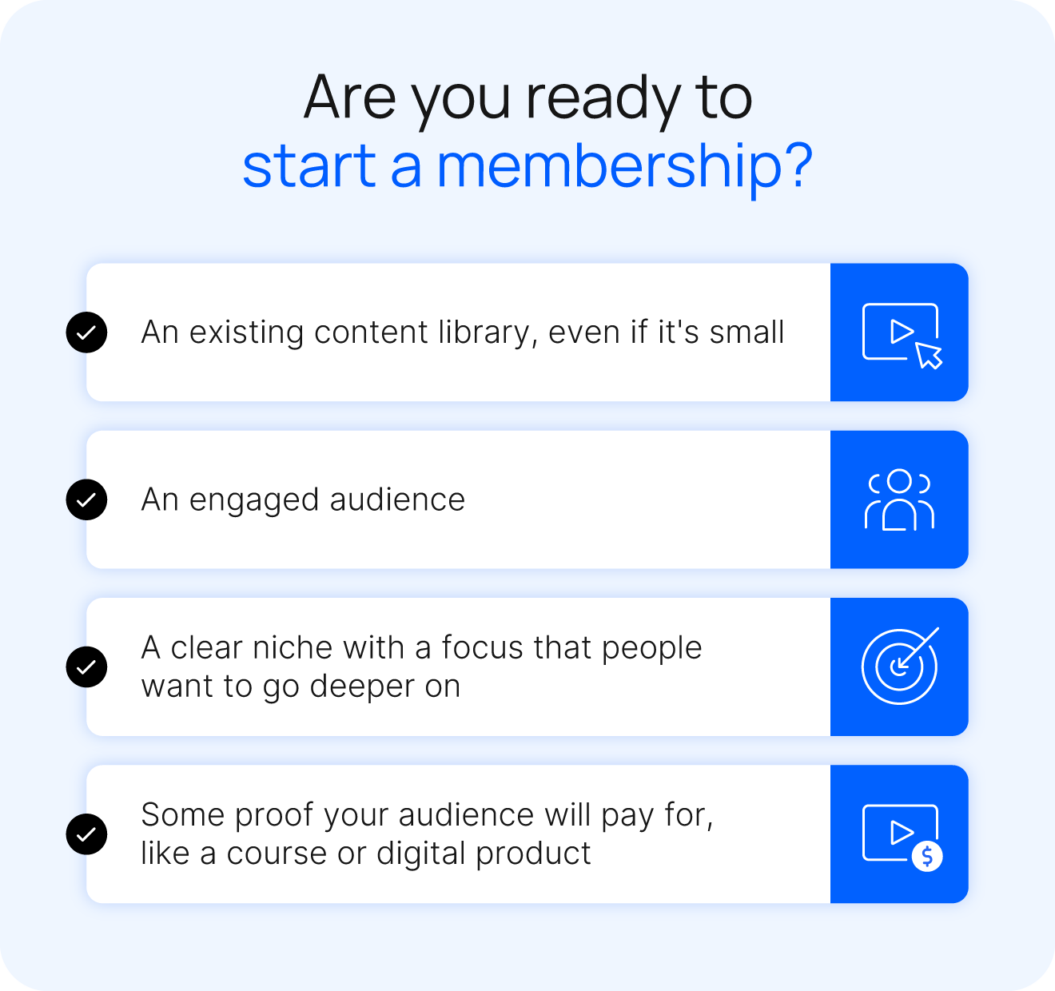
If your audience has already paid for something you’ve made, that’s a strong signal they’ll pay again. The next step is giving them a dedicated home to come back to. Once you know a membership is the right fit, your membership pricing strategy is the next thing to nail down.
Justin Rhodes had exactly that when he launched Abundance+. His homesteading YouTube channel had built a loyal audience, but his membership was held together with WordPress plugins that constantly needed maintenance and couldn’t deliver content seamlessly across devices.
After migrating to Uscreen and launching dedicated apps, Abundance+ grew from $30,000 to over $130,000 a month.
How to structure your OTT content
Your OTT content is what drives engagement and keeps members subscribed. The key to success is a well-organized library that guides members through your content and gives them a reason to keep coming back, month after month.
Every successful membership library is built on three foundations:
- Evergreen content: Your most valuable, in-depth material and the primary reason someone subscribes. This is what your membership is built around, and the first thing a new member should encounter.
- Regular releases: New episodes, live sessions, or repurposed recordings like past Zoom recordings or Q&As that keep members engaged over time. Consistency builds habit, and habit drives retention.
- Community and access: Q&As, member forums, or direct access to you. This layer turns subscribers into members and gives people a reason to stay that goes beyond the content itself.
Success comes from how these three foundations work together to create an experience members can’t get anywhere else, not from how much content you have.
The OTT marketing funnel as a membership lifecycle
To ensure a successful OTT marketing strategy, it’s important to understand the customer journey.
It’s about building a system that attracts the right audience, converts them into members, and keeps them subscribed long term. The best way to think about this is as a membership lifecycle with four stages:
- Awareness: Your potential member discovers your content and brand for the first time.
- Consideration: They explore what you offer and start evaluating whether a membership is worth it.
- Conversion: They sign up and become a paying member.
- Retention: They stay subscribed, engage with your content, and become part of your community.
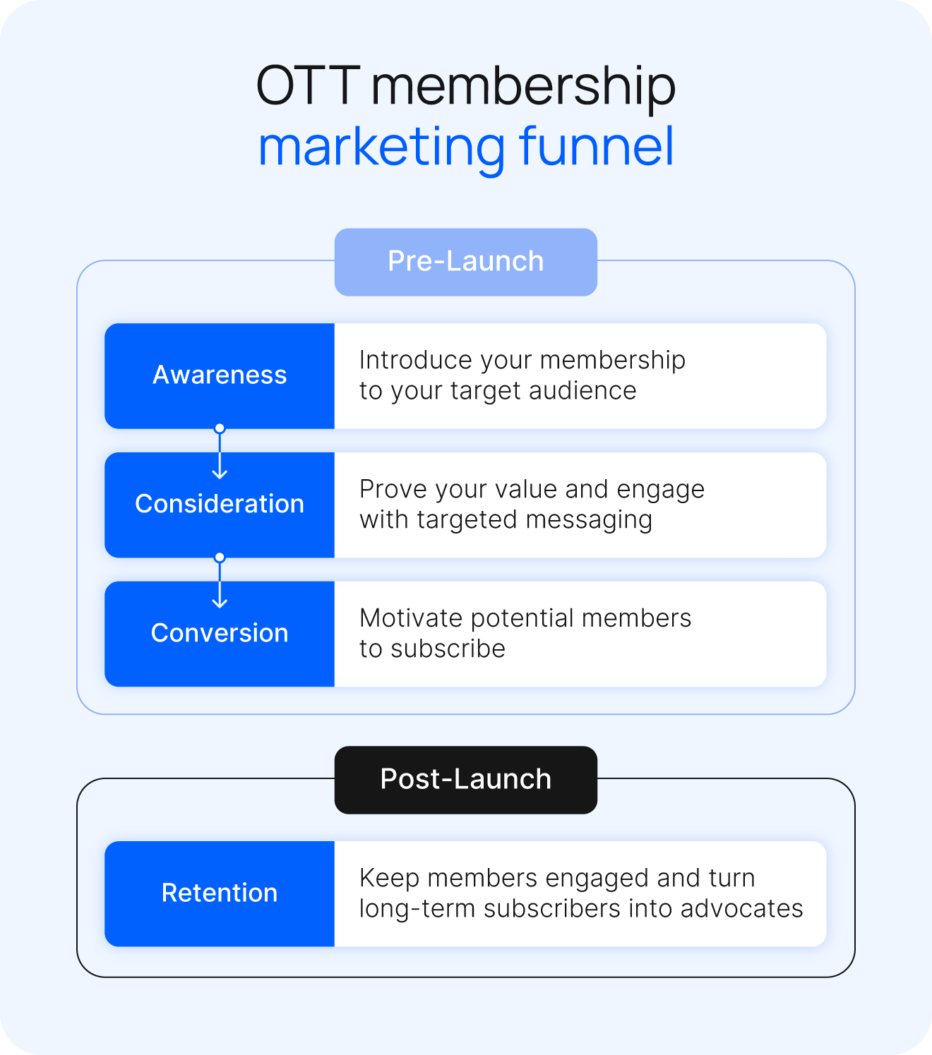
This splits our marketing funnel into two phases:
- Awareness (pre-launch)
- Retention (post-launch)
Most creators focus heavily on the first three stages and underinvest in the fourth. But for a membership business, retention is where revenue is built. A member who stays subscribed for 12 months is worth far more than one who cancels after 30 days.
Now that you understand how the pre- and post-launch phases work, let’s look at how to put them into action to build and grow a successful membership. the marketing funnel, let’s take a look at how we can leverage it to create actionable and successful marketing strategies.
Awareness (Pre-launch strategies):
Before you launch, focus on making sure your offer, your audience, and your content are all aligned. The tactics below help you do that while building momentum ahead of launch.
Set a release date
A launch date creates accountability and gives your audience something to look forward to. Give yourself enough time to properly prepare your membership, and only commit to a date once you can clearly explain what your membership includes and what members will receive when they join.
If you’re planning to launch with apps, keep in mind that app stores have different review processes that could delay your release if you need to make last-minute changes.
Understand your audience
Even with an existing community, it’s worth taking time to understand what your audience would realistically pay for regularly. Look for patterns in what content gets the most repeat engagement, saves, or direct feedback. That’s where your membership offer should start.
Understanding who your potential members are also helps you shape your content structure, pricing, and how you position your membership before launch.
Build your lead capture
Your landing page is the first place potential members go to decide whether your membership is worth joining. Before launch, it should clearly communicate what your membership includes, who it’s for, and why someone would pay for it month after month. Think of it as the first real test of your value proposition.
Use it to start capturing leads ahead of launch with an email sign-up, a waitlist, or a teaser of what’s coming. The goal is to build an audience that’s ready to convert on day one.
Content strategy
Before launch, focus on organizing what you already have rather than creating something new. Bundle your existing content into a clear, structured format that members can work through.
Then use supporting content, such as blog posts or social posts, to establish your expertise and drive awareness ahead of launch. A starting library that feels organized and valuable will do more for your membership than a large, disjointed one.
Outreach strategy
Social proof is one of the most effective ways to build credibility before launch. Reach out to trusted voices in your niche, whether that’s influencers, bloggers, or peers who can offer early feedback or a review. Their perspective can also help you refine your positioning before you go live.
Make a list of individuals or brands in your niche and prepare a simple press kit that clearly communicates what your membership is and who it’s for.
Social media strategy
Social media is one of the best places to test your messaging before launch. Pay attention to which posts about your membership idea get the most engagement, saves, or questions. Those signals tell you what’s resonating with your audience before you commit to a direction.
Use the lead-up to launch to build excitement with informational posts, answer questions from your community, and refine how you talk about your membership based on what gets a response.
Do app store optimization research
Before you focus on keywords and rankings, get clear on how your membership would be described by someone already searching for a solution in your niche. The language your audience uses to find content like yours is the foundation of any app store optimization strategy.
Once your positioning is clear, here are some best practices to improve discoverability:
- Use strong keywords in your app title and your description.
- Mention features that make your app stand out from the rest.
- Include clear images of your app so users know what to expect.
- Pay attention to the region of your target audience, as this can influence the search language of your users.
Retention/engagement (Post-launch strategies)
A launch gets members in the door, but what happens after is the key to stable revenue. You should focus post-launch on delivering consistent value to keep members engaged and building the kind of experience that makes canceling feel like a loss.
Create targeted campaigns
Where pre-launch campaigns focus on building awareness and driving sign-ups, post-launch campaigns should focus on bringing members back into your content experience and reinforcing the value of staying subscribed.
Social media campaigns, giveaways, and contests work well here, especially when tied to a new content drop, a seasonal theme, or a membership milestone. The goal is consistent re-engagement that keeps your membership feeling active and worth staying for.
Send notifications for new content
Push notifications are one of the most direct ways to bring members back into your membership. Use them to re-engage inactive members, drive attendance to upcoming live sessions, and keep your content front of mind between releases.
A predictable content cadence, paired with timely notifications, gives members a reason to keep coming back regularly. A steady rhythm of new content does more for retention than sporadic large releases.
Consider paid advertisements
Paid ads work best when your offer is already clear. Before spending on a paid strategy, make sure you can clearly communicate what your membership includes and why someone would join. Paid traffic validates interest in a well-defined offer. It doesn’t fix an unclear one.
Start small before launch with targeted ads on the platforms where your audience is most active. Short, specific messaging tends to outperform broad awareness campaigns at this stage. Use the results to understand what resonates before increasing spend.
Over time, a more structured OTT advertising strategy can help you scale what’s working.
Focus on building your community
Content keeps members subscribed, but community is what keeps them coming back. A strong community gives members a reason to show up even on weeks when they haven’t watched anything new. It creates a sense of belonging that content alone can’t replicate.
Use your post-launch phase to actively build that space. Prompt discussions, respond directly to members, and create opportunities for members to connect. The more invested members feel in your community, the harder it becomes to justify canceling.
How data impacts your OTT content strategy
Your analytics are one of the most useful tools you have for growing your membership. The key is knowing what to look for.
A few key things to pay attention to:
- Subscriber count: Track how your member base grows over time to understand which marketing efforts and content releases are driving the most sign-ups.
- Churn rate: Monitor how many members are leaving and when, so you can spot patterns and act before more members disengage.
- Average watch time: See which content holds attention longest and use that to guide what you create more of.
- Devices: Understand which devices your members watch on most so your content experience is optimized where it matters.
- Countries: Know where your audience tunes in from to create more targeted content and marketing strategies.
Use these insights to identify your top-performing content, spot where engagement weakens, and track when members are most likely to churn. From there, let your engagement trends guide your content calendar so that what you create next is always informed by what’s actually resonating.
Using mobile apps to strengthen your OTT strategy
How your members watch directly influences what you create and how you deliver it. Mobile and TV apps give you the behavioral data to make those decisions, making them powerful drivers of engagement and retention for your membership.
Here’s where to start:
- Compare engagement across mobile, TV, and web to understand where your members are most active.
- Identify which devices drive the longest viewing sessions and optimize your content format and length accordingly.
- Use push notifications to re-engage inactive members before they disengage completely.
In the Lab+ is a good example of this in practice. Their members are athletes who need to access training programs on the go, so mobile was the natural home for their content.
After launching two mobile apps on Uscreen, their apps accounted for nearly 79% of total viewing hours, and they nearly doubled their viewer count in the same year. The content strategy aligned with the behavior, and the membership grew as a result.
Refine your OTT strategy with Uscreen
A successful OTT content strategy turns your existing content into a structured, recurring revenue system. That comes down to organizing your library clearly, understanding your audience, refining your content distribution, and using data to continuously improve your approach over time.
Uscreen gives you the tools to put that strategy into practice, from delivering content across every device to managing subscriptions and tracking the data that keeps your membership growing.

FAQs
OTT video content is delivered directly over the internet to any device your audience uses, without the need for cable or satellite.
Most successful memberships launch with a small, focused library and build from there. Structure matters more than volume.
A small, engaged audience in a clear niche can absolutely support a profitable membership. Many successful Uscreen creators started with just a few hundred followers.
Consistency matters more than frequency. Pick a release cadence you can sustain and stick to it.