
Finding the perfect course price can be tricky. It’s a delicate balance between what you feel your content is worth, what customers are willing to pay, and your revenue goals.
As experts in video monetization, we’ve seen how creator economy challenges like low platform payouts make controlling your revenue more important than ever. Pricing your content effectively is a key part of that.
In this guide, we’ll walk you through how to price an online course and share best practices to keep in mind as you start thinking about course monetization.
What factors impact pricing online courses?
When starting out, you may ask yourself questions like how much do online courses typically cost. One way to answer this is by benchmarking your pricing against similar courses in your niche, considering what competitors charge, the depth of their content, and the additional value they provide.
These factors show the value you’re offering, the investment needed to create and promote your course, and how your price compares to other options on the market. Evaluating them alongside competitor benchmarks helps you set a price that works for both you and your audience.
Let’s dive further into each.
Experience
Experience refers to the depth of your knowledge, skill, and expertise. It’s your:
- Professional background
- Academic qualifications
- Personal accomplishments
- Demonstrated mastery of subject matter
- Personal brand and brand recognition
- Niche/category ownership
Imagine two creators:
- John, a hobbyist who has been practicing for five years and has a small following on Instagram
- Sarah, a professional photographer with 20 years of experience, who has published books and won a few awards
While both creators can offer valuable insights, Sarah brings more credible experience. This increases the perceived value of Sarah’s course offerings and lets her charge higher prices for her courses.
Time
The time you spend creating your online course should also be factored into the price-setting equation.
Consider:
- Creation: How long it took you to make the course, including planning, research, content creation, filming, editing, and setup
- Management: The time you spend managing the course, including answering student questions and marketing it
- Updates: The time you will spend updating your courses regularly to stay relevant
The more time you spend creating or updating your course content, the higher you should charge for it.
Marketing costs
This refers to all the money you’ll spend marketing your online courses including ads, email campaigns, SEO efforts, and blog posts.
A good starting point is to set a monthly marketing budget and divide it evenly across your channels. As you start to see which platforms bring in the most traction, you can shift more of your budget toward what’s working.
For example, when launching Freelance Writing Essentials, we leaned into Facebook ads and content marketing, allocating 25% to ads and the rest to content. This allowed us to reach a high-quality audience without overspending.
Keep in mind that marketing costs vary greatly depending on your strategy. Build your strategy around your budget so every dollar is used intentionally, and factor these costs into your course pricing so you don’t spend more than you earn.
Course content
Different course topics have different markets. The value learners place on that knowledge varies widely.
A course’s perceived value is directly related to its complexity and professional application. For instance, skiing lessons will be more expensive than yoga classes.
Here are three examples:
| Course | Skill level | Prerequisites | Audience size | Price |
| Pilates & Yoga with Katja | Beginner | None | High | $23/month or $232/year |
| Filmmakers Academy | Intermediate | Interest in technical film skills and equipment like cameras | Medium | $40/month or $270/year |
| Big Picture Skiing | Advanced | Ski equipment and basic knowledge | Low | $50/month or $350/year |
Yoga classes appeal to a large, general audience with no prerequisites, which keeps the price lower but allows for high volume.
Filmmaking is more niche and requires technical interest and specialized equipment, so fewer people teach it — meaning those who do can charge a bit more.
Skiing lessons target a much smaller audience, but because learners often invest heavily in the sport, they’re willing to pay more for expert instruction.
When considering your own pricing, look at your topic through the lens of niche size and potential impact. The narrower and more specialized your course is, the higher its perceived value and course cost.
Competition
You’re going to have competitors for any course you launch. Competition comes from all angles: Udemy, Coursera, other creators, and even your friends!
When the team at Peak Freelance re-launched Advanced Crash Course in Writing, an advanced course for freelancers, there were plenty of options available to buyers. So in order to figure out how to position our course properly we needed to understand our competitors.
To learn more, we first looked at Udemy. On Udemy alone, hundreds of freelancing programs and mini-courses were available, at much lower prices than we’d charge.
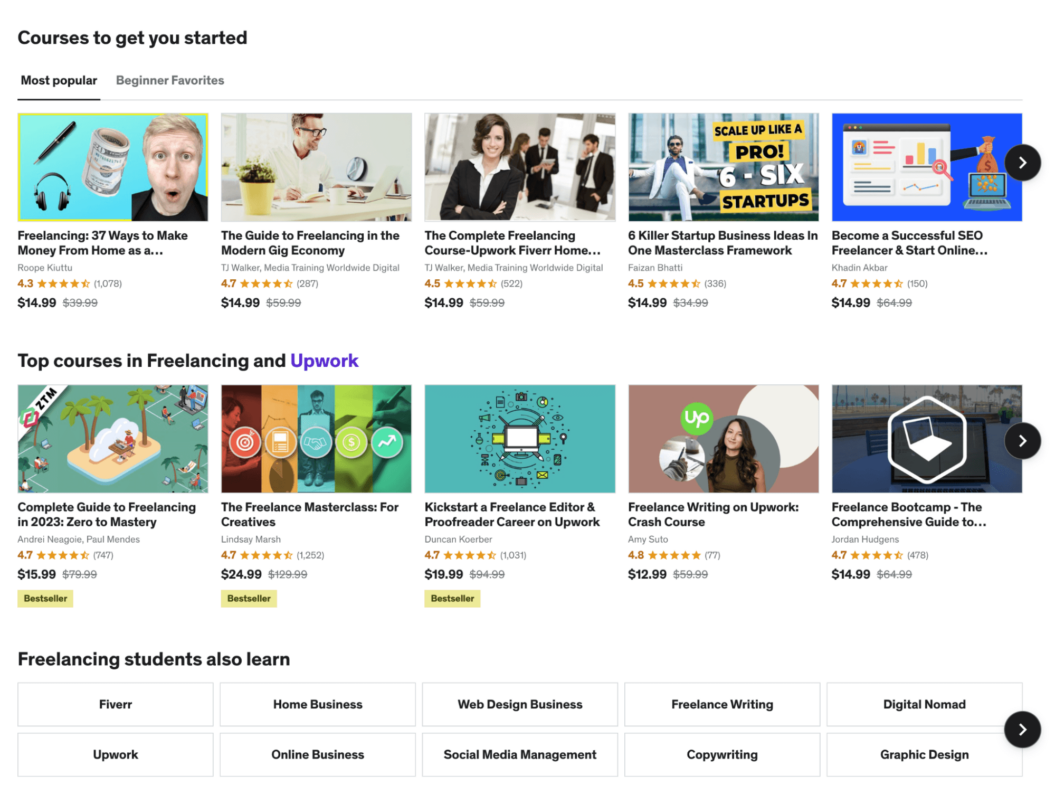
The Udemy courses under $50 were short and less comprehensive. And other than Seth Godin, who sells his freelancing course for $199, none of the authors stood out.
Since the Advanced Crash Course in Writing is taught by big industry names like Paul Jarvis and Kaleigh Moore, we knew a high price was reasonable. Our course sells for $149, a great supplemental income to our primary membership offering at Peak Freelance.
- Browse leading marketplaces like Udemy and Coursera.
- Make a list of competitors in your niche.
- Find out what they are charging and their offerings.
- Read what customers say about their pricing and be strategic.
- If you can offer more value or unique insights, you can justify a higher price point.
- If your brand isn’t currently competitive, look for ways to enhance your offering so your pricing clearly reflects the value you provide.
7 steps for pricing your online course
Pricing your online course starts with strategic actions to help you understand your audience and position your offering for maximum impact.
Follow these steps to learn how to price online courses and evaluate your pricing strategy.
Use our free tool to pinpoint your ideal membership price in just 3 steps, leveraging a decade of data.
Step 1. Do market research
Your first step is understanding the competitive landscape.
Check out courses on Udemy and Coursera to see how similar courses are priced and packaged. Review platform-specific pricing guides such as Vimeo or Patreon to get a better idea of pricing ranges across popular course-hosting platforms.
Then, dig into social media platforms to research what creators in your niche are offering and how to stand out.
Focus on:
- Course prices
- Format and delivery style (video, live, text-based, hybrid)
- Additional perks (webinars, worksheets, community, etc.)
- Target audience (beginner, intermediate, advanced)
Check out reviews and ratings of comparable courses to understand their strengths and weaknesses. Use these insights to sharpen your unique selling point (USP) and set a price that reflects the value you deliver.
Step 2. Know your costs
Every course has production costs. These include things like your time, software, hiring help, and any other resources you need to deliver the course.
If you don’t know what these are, here’s how to figure it out:
- Calculate your production costs: Include everything from software subscriptions to hired help.
- Factor in ongoing costs: Consider hosting, marketing, or any other recurring expenses related to maintaining and selling your course.
- Include your time: Don’t forget to value your own time spent on creating and maintaining the course.
The table below gives a sample breakdown of common costs for creating and running an online course:
| Item description | Estimated cost |
| Initial production costs | |
| Software (video editing, screen recording, graphic design) | $200 |
| Hardware (camera, microphone, lighting, computer upgrades) | $500 |
| Hiring help (video editor, designer, transcriptionist, copywriter) | $500 |
| Your time (course planning, production, and marketing: 100 hrs at $25/hr) | $2,500 |
| Miscellaneous (stock photos, music, props, unexpected expenses) | $100 |
| Initial production subtotal | $3,800 |
| Ongoing monthly costs | |
| Hosting and platform fees | $100/month |
| Marketing and advertising | $200/month |
| Total ongoing monthly | $300/month |
Step 3. Set income goals
Once you have a clear understanding of your costs, it is easier to set an income goal. Depending on the type of course you create, you can set either a yearly goal or a monthly target.
To start, think about a realistic income goal for yourself.
Here are two questions to ponder:
- What’s your current financial situation?
If the course is your primary source of income, you may want to set a higher income goal. If it’s a supplement to your main membership business or alternative revenue streams like live streaming, you can set it lower.
- What’s your unique value proposition?
Define what unique value your course offers. Is it a comprehensive course from industry experts that can command a higher price? Or is it a basic introduction aimed at a wider, more price-sensitive, audience?
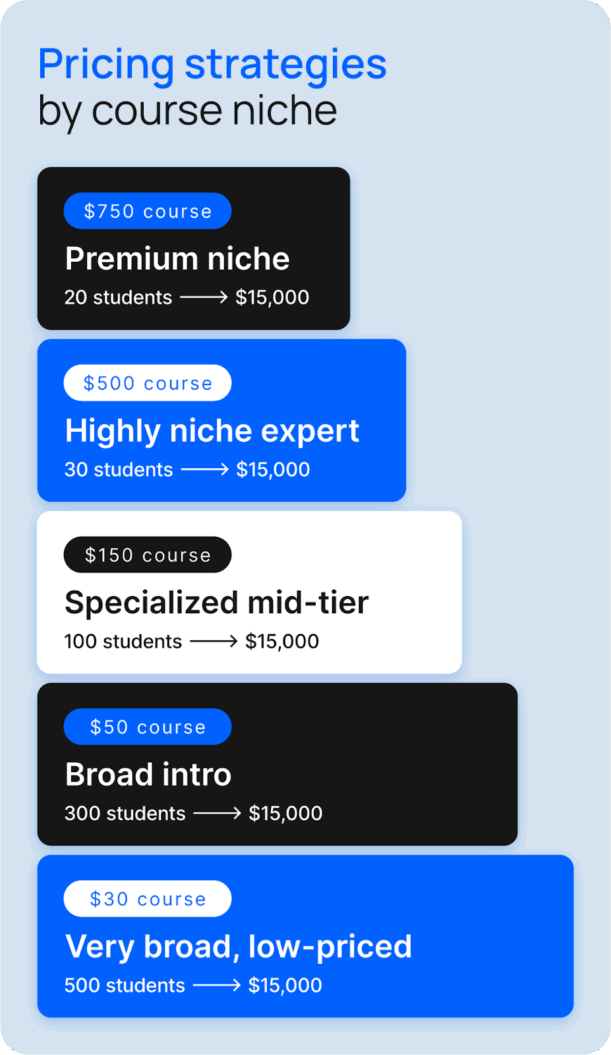
Say you want to make $15,000 from your course in the first year. That’s a great start, but how do you know if it’s achievable? The next step is to figure out how many students you need to reach this goal.
Step 4. Consider how many people will buy your course
The key to pricing a course is knowing the number of students you can realistically attract and retain. If you have a mailing list of 10,000 people, with a conversion rate of 1%-3%, expect to sell your course to 100-300 of those people.
Think about if your course offering will work for your entire audience, or if you are targeting a smaller group of your existing customers.
If you plan to launch your course in six months, look at your current audience growth. How much does your audience typically grow each month? Use that percentage to predict your audience size.
Then, you’ll want to:
- Estimate enrollment numbers: Set the number of new enrollments you can expect from your marketing efforts. This might need some market research and testing.
- Calculate cost per enrollment: Divide your total costs by the estimated number of enrollments to get this.
If you realize that the required student count is a stretch too far, you can reassess your income goal or pricing strategy.
Step 5. Choose your pricing model
Now that you know what goes into your pricing, let’s look at the different methods available to decide on your pricing strategy.
Cost
Cost-based pricing is the most straightforward way to price your course. It means adding up the total cost of creating and maintaining the course, and adding a profit margin on top to set your final price.
Using cost-based pricing guarantees:
- You cover expenses
- You keep making a profit
Many creators use cost-based because it’s simple and predictable. It helps you forecast your finances, as long as you understand all your costs for content creation, software, marketing, and taxes.
- Add up all these costs to determine the total cost of your course.
- Decide your profit margin.
- Use the formula:
Total Cost / (1 – Profit Margin)to calculate your course price.
Competitive
A competitive-based pricing approach typically involves setting your course price based on what others in the marketplace charge.
Imagine you’re a fitness instructor launching your first online course on “Holistic Fitness and Wellness.” Before setting your price, look at the market and explore similar courses.
You find:
- Course A: Covers only physical fitness at $100
- Course B: Covers physical fitness and diet at $150
- Course C: Covers physical fitness, diet, and mental wellness at $200
Given that your course also covers all three areas (physical fitness, diet, and mental wellness), you may price your course around the same range as Course C.
However, if you have unique features or benefits that Course C doesn’t offer, price your course slightly higher to reflect that additional value.
- Look at similar courses in your niche to see what they charge.
- Evaluate course content, support, interaction, and any bonuses or premium resources.
- Decide on a competitive price based on your research and the value you offer.
Value
Value pricing involves pricing your course based on your customers’ perceived value rather than the development cost. It’s difficult, but effective when done correctly.
Say you create a dance instructor bootcamp that guarantees students a job post completion. If a student with little dancing skills lands a job paying $75,000 a year after taking your course, the perceived value is extremely high.
If you price the course at $1,000, it may seem like a lot, but when measured against a $75,000 return, it’s worthwhile for the student.
- Consider what someone might be willing to pay for your course’s benefits.
- Research similar courses and understand how your value proposition differs.
- Experiment with different price points and track how your market responds.
- Communicate the value clearly with a strong marketing and sales strategy.
Subscription
The subscription business model refers to charging students a recurring fee (monthly or annually) to access course materials. Most Peak Freelance courses and masterclasses are included in our membership fee, which is $49 per month.
Consider a membership site like Collective Kula. Instead of paying for each video, you pay a monthly fee for access to their entire library of medical courses.
Subscription and membership pricing works best for creators who offer a wide range of courses or provide frequent new content for subscribers.
Many video creators opt for a subscription-based pricing model to earn consistent revenue and stay competitive.
- Review the number of courses you offer, how often you update them, and the breadth of topics to determine if a subscription model is attractive.
- Factor in production costs, platform fees, and transaction fees to ensure your pricing covers expenses and provides a profit margin.
- Consider offering multiple subscription tiers, with higher tiers including extra benefits like consultations, community access, or early access to new courses.
Step 6. Use an online course pricing calculator
Course pricing calculators help you get a feel for what your course price should be based on all these factors. The Uscreen team created one for you to do some heavy lifting.
Here’s the data you’ll need and how to get it:
- Monetization model: Decide if you’re selling your course as a one-time purchase or subscription.
- Revenue goal: Determine how much you want to make, either as monthly recurring revenue (MRR) or total sales.
- Audience size: Add together your potential students from email lists, social media followers, and subscribers across platforms like YouTube.
- Estimated conversion rate: Use historical data if available, or estimate 1%-3% if this is your first course.
- Development costs: Take the total from Step 2, including production, software, and hired help.
- Payback period: Decide when you want to recoup your investment; this is usually expressed in months.
- Average price of competitor courses: Use your competitor research to find what people normally pay for similar courses.
Plug all these numbers in, and this calculator will help you price your course.
Step 7. Test and validate your pricing
The price you choose isn’t set in stone. Once you’ve launched your course, you can play around with pricing annually or quarterly to make more sales across your course business.
The best times to experiment are during new course launches, major content updates, audience growth, low sales or conversions, seasonal promotions, or competitor pricing changes.
Two ways to experiment with pricing are upselling and discounts.
- Upselling: Offer additional services or products to enhance the original course’s value. Some examples include one-on-one coaching sessions, membership upsells to access exclusive communities, live streams, and additional materials.
- Discounts: Lower the price of your course for a limited period of time through early bird discounts, student discounts, group discounts, or seasonal holiday sales. Discounts attract more customers and encourage them to act quickly.
Tips to increase the price for your online course
Here are a few tips on how to effectively price your course:
- Understand your audience: Identify their needs and pain points, know what they value in a course, and see what others have paid for similar content to guide your pricing.
- Pay attention to competitors: Know what others charge to avoid overpricing or underpricing your course.
- Be flexible with pricing: Test different price points, offer discounts, and consider subscriptions or installment plans.
- Write down all your expenses: Track every cost, including small fees, to better predict overall profits.
- Communicate your course’s value: Highlight unique assets, student outcomes, and additional perks.
- Don’t undervalue your content: Too many course creators get imposter syndrome and worry that their course is too expensive. The truth is, if you provide value and have the skills and expertise, people will pay for your work.
Scale your online course monetization with Uscreen
Remember, pricing isn’t just a set-it-and-forget-it affair. Learning how to price an online course is an ongoing journey of recognizing your worth and the invaluable insights you offer your students. Make it a point to revisit your pricing strategy periodically to stay aligned with market dynamics and your evolving content.
As owning your audience becomes an increasingly important trend in the creator economy, it’s essential to use the right tools to manage, grow, and monetize your courses effectively.
Uscreen makes it easy to host your courses and build a connected community, helping you drive consistent, recurring revenue.

Online course pricing FAQ
Courses are structured programs designed to teach specific skills or knowledge over time, often divided into modules or lessons for self-paced learning. They cover topics in depth with videos, readings, and quizzes, transforming beginners into proficient users or experts.
Example: Filmmakers Academy
Workshops are shorter, interactive, and hands-on, focusing on practical skills that participants can apply immediately. They provide real-time engagement and a collaborative environment for learning, experimenting, and sharing experiences.
Example: 3 Ways To Price Your Membership For Growth
It can cost anywhere from $500 to $10,000 to develop an online course. The main expenses include the labor involved in development, software program costs, and marketing costs.
The average course typically costs between $15 and $200.
When deciding on your pricing, consider factors such as:
The costs of creating your content
Your revenue goals
The average price of competitors’ courses
This will help you set a competitive price that accurately reflects the course’s value.
One-time courses are a single purchase, so they usually cost more. Keep in mind the full value of your course, any extras like coaching or certificates, and how it compares to similar courses.
Membership courses are sold on a recurring basis, so pricing focuses on long-term revenue and retention. Think about what’s affordable for members, the ongoing value you provide, and your revenue goals over time (usually quarterly or yearly). Trials, introductory pricing, or tiers can help attract and retain members.
For both types, understand your audience, check competitor pricing, and make sure your price accurately reflects the content’s value.
Here are some ways to increase the value of your course:
Add interactive elements like quizzes and group coaching.
Invest in high-quality videos.
Provide extra resources like workbooks, podcasts, templates, and tools.
Include a community area or private Facebook group in the price.
Make sure your course is accessible on multiple devices by using one of the best online course platforms.
Showcase past student testimonials.
Offer tiered pricing or packages to give options for different budgets.
Add live Q&A or coaching sessions for a personal, interactive touch.
Provide certificates or accreditation to increase perceived value.
Include limited bonuses or early-bird perks to encourage enrollment and make your course feel exclusive.
Add continuous updates to keep content fresh and relevant and maintain long-term value.