- Pay-per-use is a low-barrier, transactional model best for high-value, one-off events or creators who publish irregularly.
- Subscriptions offer predictable, recurring revenue for creators with consistent content libraries and engaged communities.
- A hybrid approach combines both models, creating a stable baseline while maximizing revenue through premium, add-on content.
Choosing between pay-per-use vs. subscription can be challenging, since both are effective ways to monetize your content. Each approach has distinct advantages, and the best fit depends on your content type, business goals, and audience preferences. Understanding how each model works helps you make an informed decision to maximize revenue.
While a pay-per-use approach offers the flexibility to capture casual viewers, subscriptions provide a predictable foundation that can help your business grow. According to recent creator economy statistics, subscriptions are the most lucrative monetization model, earning 100% more than a one-time-focused model.
We’ll explore each monetization approach, including hybrids, so you can choose the one that works best for your business.
| Model | How It Works | Best For | Revenue Potential (per user/month) |
| Pay-Per-Use | Customers pay for what they use | Irregular or unpredictable usage | $5–$50 depending on usage |
| Subscription | Recurring fee for ongoing access | Consistent or frequent usage | $20–$100+ depending on plan |
| Hybrid | Subscription cost plus an extra charge per product purchase | Mixed usage patterns | $15–$75 base + $5–$50 usage |
| *Figures are averages; actual revenue depends on your content type and its value. | |||
Pay-per-use (pay-per-view) model
A pay-per-use or usage-based model is exactly what it sounds like. Users only pay for what they consume on a case-by-case basis, whether it’s watching a specific video, attending a live stream, or accessing a digital product.
This model is often more attractive to new fans because the entry cost is lower than a full membership/subscription while still allowing them access to a creator’s products and community. But because revenue is tied to individual, one-off transactions, creating a pay-per-view website may not generate income as reliably as other options.
Like live streaming or on-demand (TVOD) models, pay-per-use pricing may be best for creators who want to supplement their income and attract new users or those who frequently host paid events like workshops and classes.
Some brands, like Fittest Core, offer pay-per-view workouts to non-subscribers, allowing users to test their services before committing to a subscription or enjoy them as a one-off. While this is technically hybrid monetization, the pay-per-use feature is a great way to engage newer users and turn them into regular subscribers or to supplement recurring revenue with one-off sales.
Pros
- Create once, keep selling: A single product or service can generate ongoing revenue without requiring continuous new content.
- Low barrier to entry: One-time pricing lowers the cost for customers, making it easier to attract and convert new followers.
- High value for one-offs: Individually priced products are perfect for high-production specials, certifications, or events.
- Clear value exchange: Give customers exactly what they pay for, no strings attached.
Subscription fatigue is on the rise, with 41% of respondents to a 2025 study reporting they’ve canceled a service, up from 35% earlier that year. With some hesitant to join another membership, pay-per-use lets fans choose what and how they purchase. It’s an à la carte menu instead of an all-you-can-eat buffet — their options are more limited, but they can be sure they’re getting what they want.
Cons
- Inconsistent income: Revenue can swing wildly based on your marketing push or content schedule.
- Higher acquisition cost: You must continuously attract new customers to generate revenue, rather than relying on recurring revenue from existing ones.
- Lack of community: It’s harder to build a loyal, engaged community when interactions are purely transactional.
Success on a pay-per-use model can be unpredictable, making it better suited for specific initiatives or as a supplemental source of passive income. Without the baked-in recurring revenue of a subscription or membership model, creators have to appeal to their customers each time they launch a new product, which may become labor-intensive and expensive.
While subscriptions provide steady revenue and help build a loyal community, pay-per-use works well for creators experimenting with monetization or gauging interest in their content. It’s also an excellent option for creators who prefer a simpler, less hands-on approach than running a subscription service.
Revenue potential
Potential revenue per transaction: Generally $5–$50 per item or view.
The revenue you can earn from a pay-per-use model depends heavily on the volume and interest of new traffic. If you want to earn more, you need to constantly find new buyers or release more products.
Typical earnings per transaction vary by content type:
- Live-stream classes: $10–$20 per session (e.g., a single fitness class)
- PVOD rentals: $5–$15 per view
- Online courses or workshops: $30–$50 per purchase, offering higher-value one-time sales
This model works well for creators offering premium, standalone content who want to generate per-sale revenue without the ongoing demands of a subscription business.
Subscription model
The subscription model is one of the most popular options for modern digital creators. Instead of a one-time transaction, users pay a recurring monthly or annual fee for ongoing access to your entire library or a specific tier of content. Content creators and streaming services commonly use subscription video on demand (SVOD) to generate recurring revenue while leveraging extensive libraries.
This model is best for creators who continuously produce new content, like fitness coaches with weekly workouts, educators with deep archives, or entertainers who consistently release content. A subscription prioritizes long-term value over short-term profit, providing more value to subscribers and allowing for sustainable growth.
Platforms like Eternal Family highlight how predictable subscription revenue supports growth. Using analytics to guide curation, app strategy, and licensing, the team could make strategic shifts without worrying as much about revenue fluctuations. After relaunch, the platform saw 350% growth and a 25% engagement rate, demonstrating how stable revenue can drive improvements and engagement.
Pros
- Predictable monthly recurring revenue (MRR): You can anticipate exactly how much will come in each month, making it easier to plan for your personal and business expenses.
- Increased customer lifetime value (LTV): A subscriber who stays for a year at $20/month contributes more to your income than a one-time $50 buyer.
- Easy automation: Passive revenue continues as long as subscribers find your content valuable.
- Community engagement: Exclusive spaces help subscribers connect, boosting loyalty and supporting long-term retention.
A subscription model is one of the most sustainable revenue streams, especially for creators with a recognizable brand. It provides a stable foundation, making it easier to grow consistently and nurture meaningful audience relationships.
Cons
- Content demands: You must consistently produce or update content to justify the recurring cost and prevent churn.
- Higher commitment: It can be harder to convince a new user to sign up for a recurring bill than for a one-time small fee.
- Churn risk: Customers may be more likely to cancel, especially if they’re paying for features they don’t actively want or use.
Plenty of creators make the subscription model work, but keeping up with ongoing demand for quality content can be challenging. Newer brands may struggle to attract and retain enough subscribers to turn a profit, and though the subscription model can provide a steady income, users can cancel at any time.
Revenue potential
Potential revenue per user: $20–$100+ per month, depending on the niche and value provided.
With a subscription model, growth can be exponential. Depending on your business model, audience, and product offerings, the subscription pricing examples you reference may use a tiered structure or a static rate. Always make sure your pricing reflects the work you do.
As long as your acquisition rate is higher than your churn rate, your revenue can increase every single month. Of course, ongoing growth can require significant effort to create high-quality content at a regular cadence.
Hybrid approach
If you feel torn between the stability of subscriptions and the high-margin potential of pay-per-use, you don’t have to choose one over the other. A hybrid model combines a recurring subscription fee with one-off purchases, offering flexibility for casual users and predictable revenue from subscribers with extra upsell potential for both.
This approach to digital content monetization allows you to secure a base of predictable revenue while still capturing extra income from premium events or exclusive products that fall outside of a standard membership. Many successful businesses benefit from this tiered customer journey, where casual users start with pay-per-view content and can gradually become subscribers as they engage deeper with your offerings.
The exact structure of a hybrid model can vary. You might offer a basic subscription with pay-per-use options for subscribers, or you could allow fans to make purchases (often at higher prices) without subscribing.
Why It Works
The hybrid model is one of the most effective tools for digital content monetization because it maximizes average revenue per user (ARPU). You get the flexibility to attract casual users with one-off tickets, the predictable revenue of loyal subscribers, and the massive upsell potential of premium add-ons.
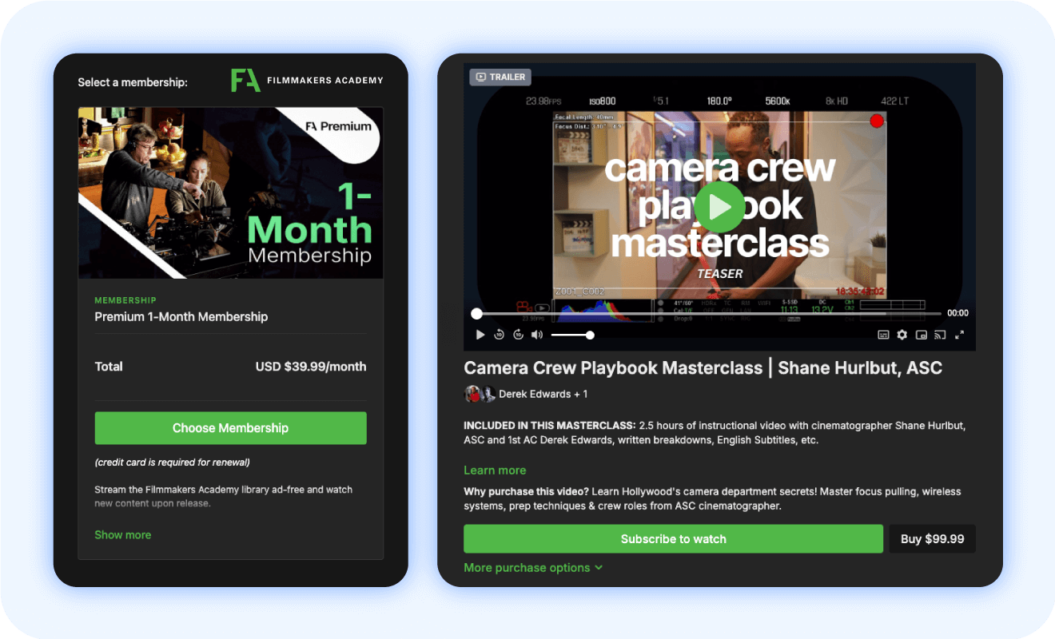
Filmmakers Academy offers both premium subscriptions and one-off purchases, allowing users to customize their experience and get exactly what they want to pay for. With a subscription, users can access the entire library of courses and resources. Still, those who are just getting started can ease into the industry or keep their focus narrow for a specific project with individual purchases.
Revenue potential
Potential revenue per user: $15–$75 base + $5–$50 per-use
To make hybrid pricing work, make sure it’s clear what is included in set prices and what costs extra. You can also encourage subscriptions with premium pricing. A subscription can be a financial commitment, but enticing users with exclusive deals may sway them.
If you offer add-ons at a discounted rate compared to one-off pricing for non-subscribers, users may be more inclined to subscribe and get more value from their purchases.
How to choose the right strategy for your brand
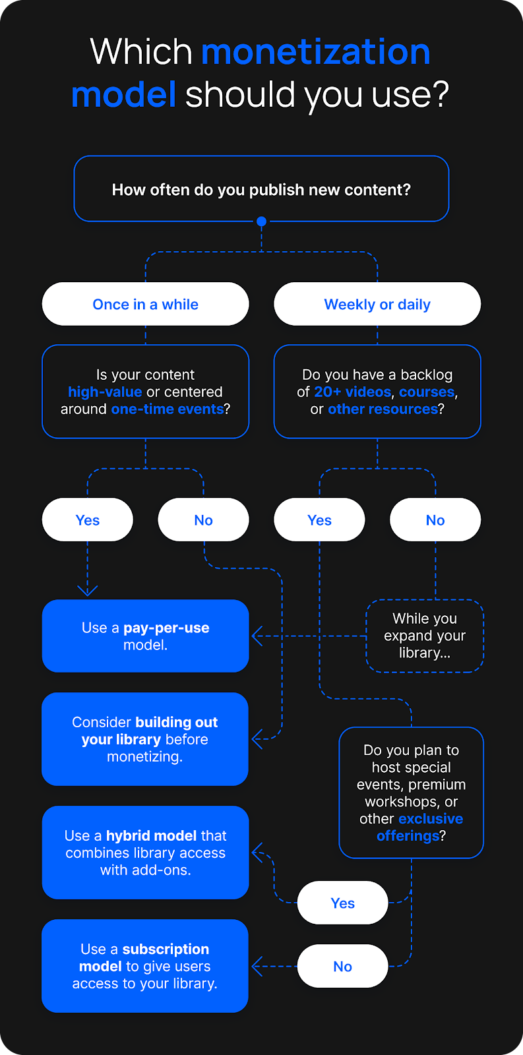
Selecting the right monetization method should align with your content’s DNA and your audience’s wallet. To find the sweet spot on a creator monetization platform, you need to look at three key pillars:
- Audience behavior: Do your users show up regularly for your content, or do you attract them when you launch something new?
- Content volume: Do you have a massive library that provides ongoing value, or a few high-value gems that stand on their own?
- Revenue goals: Are you looking for the stability of a monthly income or quick sales of individual purchases?
Beyond your goals, different content types may be better suited for specific monetization models. Consider the following models for your goals and content types:
- Pay-per-use: Infrequent but high-value events or products, such as live concerts or one-time workshops with certifications.
- Subscription: Ongoing content creation that provides accumulated value, such as weekly fitness routines and cooking tutorials.
- Hybrid: A combination of the two that offers continual content as well as optional high-value add-ons, like an annual summit or a premium masterclass.
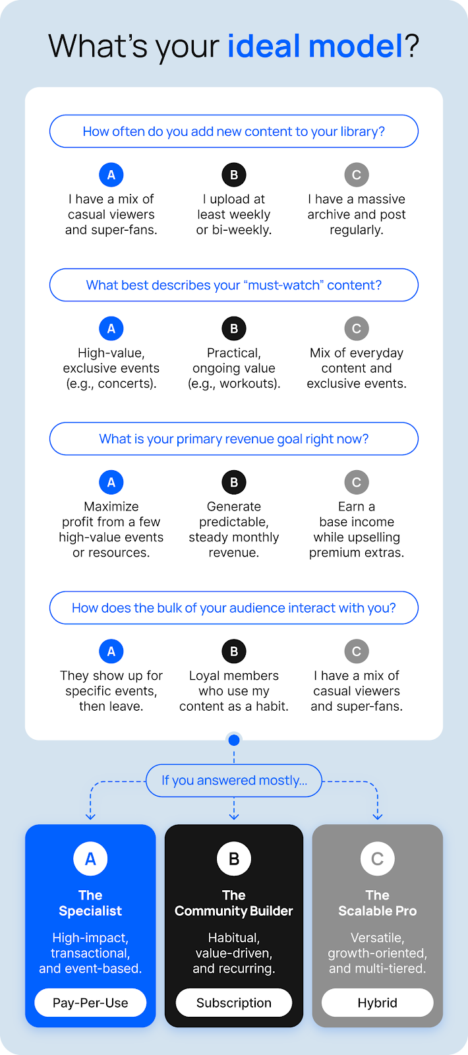
If you’re still not sure which model makes the most sense for you, take the quiz below to help you make the decision.
The most successful creators test and iterate as they grow. Start with the model that feels most natural to your current output, then use analytics to see where users are dropping off or where they ask for more.
You might start with a pay-per-use model to validate your audience’s willingness to pay, then transition into a subscription or hybrid model once your library is deep enough to provide ongoing value. Use your analytics to monitor churn and engagement, deliver what your users want, and align your monetization strategy to generate consistent revenue.
Flexibility is your greatest asset, whether you opt for usage-based pricing vs. subscription or hybrid pricing. By choosing a platform that supports all three, you can pivot your strategy as your brand evolves.
Video monetizationManage your content monetization with Uscreen
If you’re deciding between a pay-per-use vs. subscription model, you don’t have to choose one or the other. As your content library grows and your audience evolves, your monetization strategy should be flexible enough to grow with you.
Whether you’re hosting a high-energy live event or building a library of evergreen resources, the key to long-term success is aligning your pricing with the unique value you provide.
The right platform makes this transition seamless by offering the tools you need to manage multiple revenue streams in one place. Uscreen provides a complete ecosystem designed to help you take control of your monetization. So if you’re looking for the best membership site platforms or a place to build a complete content library, Uscreen offers the tools you need to run your video business.
Ready to take the next step in your professional journey? Explore Uscreen’s video monetization features today and see how easy it is to customize your path to sustainable profit.

FAQs
The primary difference is commitment and access. Pay-per-use is transactional and flexible, while subscriptions focus on long-term access and predictable revenue.
In a pay-per-use model, customers pay a one-time fee for a specific piece of content or a single event, whereas a subscription model involves a recurring fee (monthly or annually) for ongoing access to an entire content library or service.
The three most common subscription types are:
Flat-rate subscriptions: Users pay one price for unlimited access to all content.
Tiered subscriptions: Users choose from different price points based on features, content volume, or video quality.
Freemium subscriptions: Users can access basic content for free but must pay a subscription fee to access premium, ad-free, or exclusive videos.
Yes, you can combine usage-based and subscription models in a hybrid model. Many creators use a subscription for their evergreen library to maintain a steady monthly income with pay-per-view tickets for high-value live events, workshops, or exclusive specials. This allows you to monetize both your most loyal fans and casual viewers at the same time.
To price pay-per-use content effectively, consider the production value, uniqueness, and market demand. Typically, one-off access should be priced higher than the per-video cost of a subscription to reflect its exclusive nature. Always research competitor benchmarks and your audience’s willingness to pay for specialized access.