
Most over-the-top (OTT) businesses don’t lose subscribers because of one bad feature. They lose them through dozens of small moments of friction. A confusing first login, an expired payment card, a recommendation row that never updates, or a subscriber who finishes the one show they came for and never opens the app again.
Ask five OTT operators what a “normal” churn rate looks like, and you’ll probably get five different answers. The right benchmark depends on your platform, market, and content library.
Antenna’s 2025 State of Subscriptions (opens in new tab) report puts the weighted average monthly churn rate for premium subscription video on demand (SVOD) at 4.6%. Parks Associates (opens in new tab) has measured annual churn across all OTT services as high as 46% to 50%. Those are not contradictory, but two different ways of slicing the same volatile category.
One metric matters more than any benchmark: retention. It has the biggest impact on customer lifetime value (LTV) (opens in new tab) , the total revenue a subscriber generates before they leave. A one-point improvement in monthly churn, on a base of 100,000 subscribers, is worth roughly $120,000 a year (opens in new tab) in preserved revenue, per MwareTV’s analysis. That is more than most platforms spend acquiring 1,000 new subscribers.
This guide explains why subscribers leave, how to reduce churn (opens in new tab) at every stage of the subscriber lifecycle, and where to focus first with a practical 90-day roadmap.
What OTT churn actually means
OTT churn is the rate at which subscribers cancel, but not every cancellation is the same, and mixing up the two types wastes your retention effort. Splitting churn into voluntary and involuntary lets you fix each one with the right tool instead of guessing.
Here’s how the two types break down:
- Voluntary churn: A subscriber actively decides to cancel, usually over a content gap, a clunky experience, or a price that no longer feels worth it. This type needs a product or value fix, not a billing fix.
- Involuntary churn: A subscriber never intended to cancel. An expired card or failed payment ends the subscription automatically, and (opens in new tab) Recurly and other industry sources (opens in new tab) put this at 20% to 40% of total churn across digital media. It’s one of the easiest forms of churn to reduce with (opens in new tab) automated (opens in new tab) (opens in new tab) payment recovery (opens in new tab) .
The basic churn rate formula is simple. Take the number of subscribers who canceled in a period, divide by the number of subscribers you started that period with, and multiply by 100.
Churn benchmarks vary depending on methodology. Some come from independent research firms, while others come from OTT infrastructure vendors reporting operator data. Treat them as directional benchmarks rather than exact targets.
Reported rates vary by source, by market, and by whether the figure is monthly or annual:
| Source | Reported churn | Context |
|---|---|---|
| Antenna, State of Subscriptions (2025) | 4.6% monthly (weighted average) | Premium SVOD category, US |
| Netflix (Antenna) | 2% monthly, spiking to 2.5% (opens in new tab) around price increases | Lowest churn in the category |
| Parks Associates | 46% to 50% annual | All OTT services combined, US |
| OTT infrastructure vendors (MwareTV, Setplex) | 3% to 6% monthly (opens in new tab) | Vendor-reported operator averages |
| India platforms (StartupTalky, citing Ormax) | 30% to 40% monthly (opens in new tab) | Platform-level churn in a high-competition market |
There is no single “correct” number. Use the range, watch your own trend line, and treat any one benchmark as a rough guide.
Why OTT subscribers cancel in the first place
Subscribers cancel OTT services for a handful of predictable reasons, and price sits at the top of nearly every list. Poor onboarding, payment failures, and content running dry all play a role too. Once you know which of these causes is actually driving your churn, the fix gets a lot more specific.
Here are the six reasons that show up again and again in independent research:
- Price: Deloitte’s Digital Media Trends (opens in new tab) research found 41% of consumers had canceled at least one paid streaming service in the prior six months. A separate wave of the same annual survey found 47% of consumers say the cost no longer justifies the value they get. Parks Associates research has separately identified cost as a leading cancellation reason, ahead of most content complaints.
- Poor onboarding: A subscriber who never finds anything to watch in their first session rarely comes back for a second one, even though they are technically still paying.
- Payment failure: Failed payments are a significant cause of subscriber loss. Unlike voluntary cancellations, they can often be recovered with payment retries and billing recovery workflows.
- Buffering and technical friction: Operator data shows a large share of viewers abandon a stream after roughly ten seconds of buffering and do not return to that session.
- Lack of personalization: When nothing on the home screen feels relevant, subscribers stop opening the app well before they formally cancel.
- Content exhaustion: A meaningful share of subscribers join for one specific title, a season, a film, a live event, finish it, and cancel. Deloitte calls this “churn and return,” and found 24% of consumers had done exactly that (canceled, then resubscribed to the same service) within six months.
Most of these strategies map directly onto one of those six root causes, and the rest catch subscribers who are already showing signs of leaving. Subscription fatigue is also growing. The average US household now pays for four streaming services, according to Deloitte, so every platform is competing for the same limited attention.
Here is how each reason maps to the strategy that addresses it, before the article gets into the details of each one:
| Why people leave | Strategy that fixes it |
|---|---|
| Poor onboarding | First-week onboarding (opens in new tab) sequence |
| Content exhaustion | Regularly uploading new, original, and exclusive content |
| Payment failure | Smart billing and pre-dunning |
| Price concerns | Pause and downgrade options |
| Technical issues | Device coverage and stream quality |
| Weak discovery | Personalization |
Fix the first seven days of onboarding
Most cancellations trace back to a subscriber who never really got started, not one who stopped liking your content. Operator data shows subscribers who watch three or more hours of content in their first week churn at roughly a third the rate of subscribers who watch nothing at all. That first session sets a habit, or it does not.
Picture FlexFit, a hypothetical mid-size fitness streaming service with 5,000 subscribers. A new subscriber opens the app to a flat grid of 400 workout videos, finds no obvious starting point, and closes the app without pressing play.
Three simple changes improve first-week onboarding:
- Send a welcome email (opens in new tab) within 10 minutes with two or three recommended titles.
- Ask for preferences on first login and personalize the home screen.
- Encourage profile completion, but keep it to two or three fields.
All three have one thing in common: they reduce friction instead of adding more steps.
Personalize with recommendations that actually fit
A subscriber who cannot find anything worth watching does not usually complain. They just quietly stop opening the app, which is one of the six root causes above and one of the hardest to catch, because there is no support ticket to flag it.
Personalization is the solution. The widely quoted claim that Netflix recommendations drive around 80% of viewing comes from years of industry reporting, not one published study. Treat it as directional rather than definitive.
Deloitte’s research offers firmer evidence. It links weak content discovery to the same “pay too much for what I get” dissatisfaction driving voluntary cancellations.
Simple features like a “Continue watching” row, behavior-based recommendations, and content-specific emails make large libraries easier to navigate (opens in new tab) and help subscribers discover more of what they want to watch.
- A continue-watching row so people pick up exactly where they left off, on any device.
- A behavior-based row (“because you watched”) that refreshes weekly at minimum with fresh recommendations, not once at signup and never again.
- A short, content-calendar email that builds anticipation before something new drops, instead of a generic monthly newsletter that treats every subscriber the same.
Recommendations and re-engagement (opens in new tab) work best when they’re automated and continuously updated rather than configured once and forgotten. Platforms such as Uscreen include these workflows out of the box, but the same approach applies regardless of the software you use.
Keep the content pipeline moving
Content is the reason people showed up in the first place. It’s also one of the biggest reasons they leave. Antenna (opens in new tab) (opens in new tab) and Parrot Analytics have documented the “binge-and-cancel” behavior (opens in new tab) , where subscribers join for a specific title and return later when new content is released. A meaningful share of subscribers also cancel after finishing the content they originally subscribed to watch.
Regularly uploading new, original, and exclusive content remains the strongest defense. Competitors can copy pricing and features. They cannot copy your content library. It is also worth tracking which specific titles drive retention, not just which ones drive signups. The titles that attract new subscribers are not always the ones that keep them subscribed six months later.
Kill involuntary churn with smart billing
Content and personalization help subscribers who choose to stay. The next challenge is different. Subscribers who never chose to leave at all, and this is one of the fastest, cheapest fixes most platforms have sitting untouched.
Pre-dunning asks subscribers to update payment details before a card expires. It recovers a large share of involuntary churn (opens in new tab) before the payment ever fails.
Pair pre-dunning with automated payment retries to recover failed payments before they turn into cancellations. Where available, offering bank-to-bank payment options alongside cards can reduce payment failures even further because bank details change far less often than cards.
Platforms such as Uscreen automate this process. Failed payments trigger retry and recovery workflows automatically instead of requiring manual follow-up.
Offer an out that isn’t cancel
The subscribers who make it this far didn’t intend to cancel involuntarily; these are the ones who actively want to leave, at least in the moment. The subscribers who make it this far actively want to leave, at least in the moment.
Many subscribers don’t want to leave forever. They just need a temporary break. A pause option (opens in new tab) , letting someone freeze their plan for 30 to 90 days while keeping their account and history intact, converts a real share of intended cancellations into a temporary break instead.
MwareTV’s data (opens in new tab) shows paused subscribers return at a far higher rate than subscribers who fully cancel. CrocOTT’s separate analysis describes pause reactivation as “four to six times” the rate of a cold re-subscriber, using a different measurement approach; the two vendors are not counting this identically, but they agree on the direction and the size of the gap.
A lower-priced tier (opens in new tab) helps subscribers who are leaving because of cost rather than dissatisfaction. Keeping them on a lower-priced plan is usually better than losing them altogether.
Build a cancellation save flow
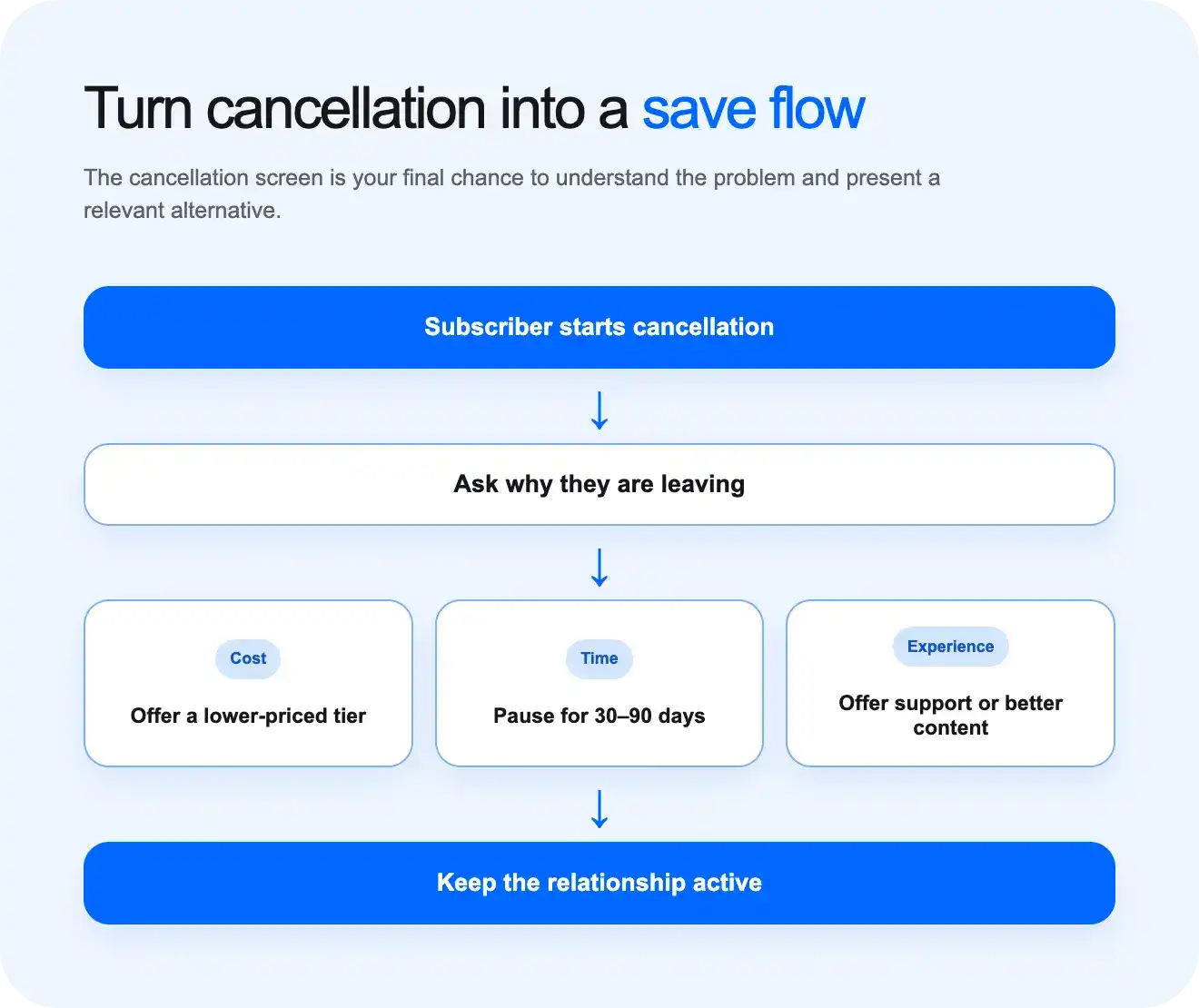
A pause option only works if a subscriber sees it before they finish canceling, which is why the cancellation screen itself is worth designing on purpose. It is the only “save desk” most OTT platforms get. There is no phone call, no agent, no chance to talk someone through it. That one screen has to do the work.
Two things make a cancellation flow more effective:
- Show subscribers what they’ll lose, such as an upcoming release or unfinished episode.
- Ask why they’re leaving so you can offer the most relevant alternative, whether that’s a discount, pause option, or technical support.
Catch at-risk subscribers before they tap cancel
Everything so far helps after a subscriber shows signs of leaving. A better approach is spotting those signs before they ever reach the cancellation page.
Three signals matter most, per operator research:
- Viewing time drops from a baseline of five or more hours a week down to under two hours.
- No login in 10 or more days, marking the shift from occasional viewing to real disengagement.
- Repeated buffering, three or more incidents in a rolling seven-day window.
A subscriber showing two of these three signs is markedly more likely to cancel within the next 30 days. Acting at this stage with a recommendation, reminder, or limited-time offer is usually more effective than trying to win subscribers back after they’ve already canceled.
Cover every device and protect stream quality
Engagement scoring depends on subscribers actually being able to watch without friction in the first place, which is where device coverage and stream quality come in. This gets treated as an afterthought on a lot of retention checklists, despite backing it up with some of the clearest churn data of any single tactic.
Subscribers who watch across multiple devices usually churn less. A viewing habit that spans phones, TVs, and browsers is harder to break than one built around a single screen. Priority order for most platforms in 2026 is mobile first, then the major connected-TV platforms, with a web fallback so nobody needs to install anything just to try you out.
Stream quality is a more binary problem, and the evidence for it goes beyond any one vendor. A foundational study of video engagement (opens in new tab) by Dobrian and colleagues, presented at ACM SIGCOMM, found that rebuffering has the single largest effect on engagement of any streaming quality metric measured, across short-form, long-form, and live content alike.
Operator data also suggests many viewers abandon a stream after about 10 seconds of buffering and never return. The technical fixes are well understood. Use adaptive bitrate streaming, CDN edge delivery, backup stream sources, and real-time monitoring to reduce interruptions.
Turn subscribers into a community
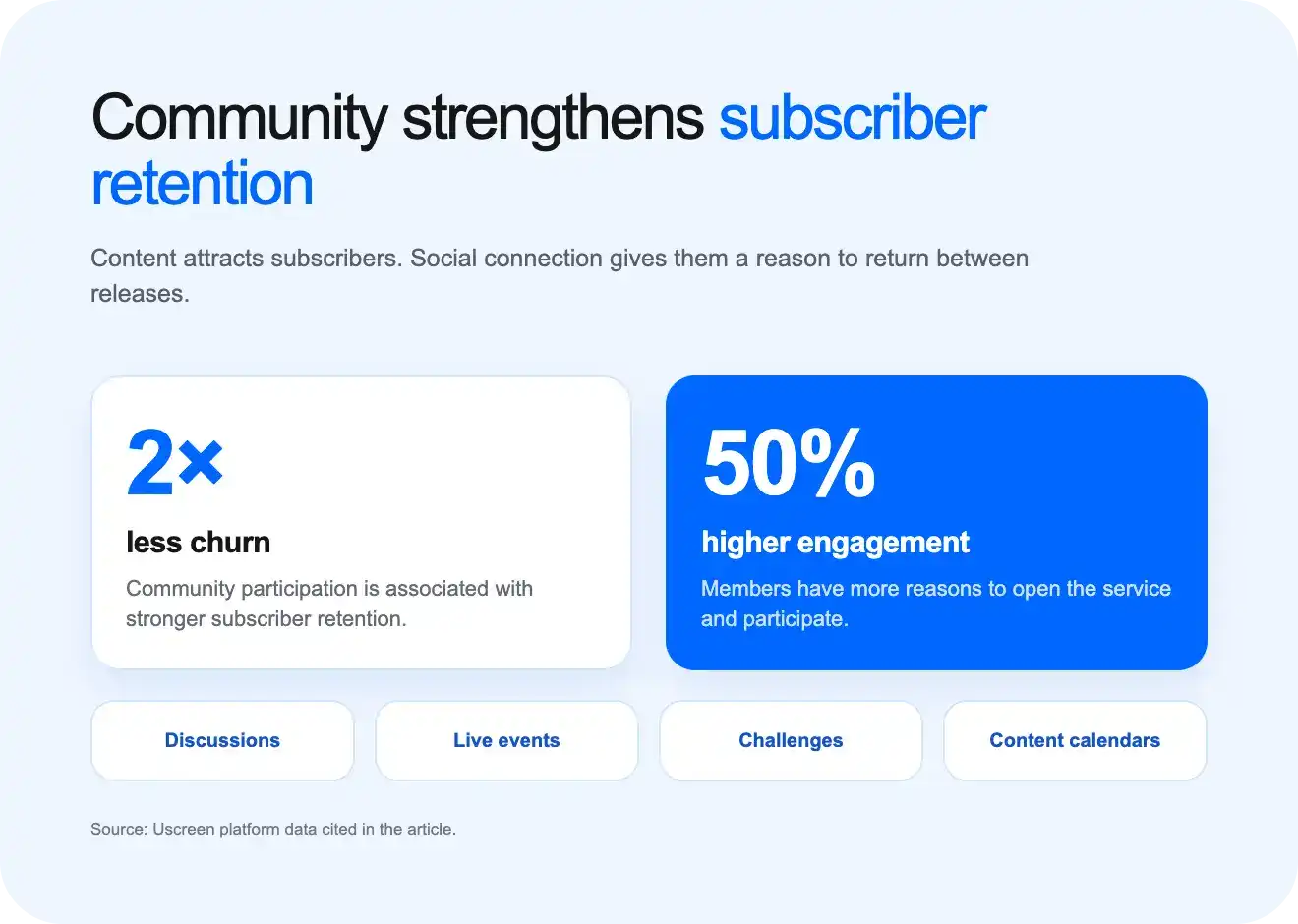
Content may attract subscribers, but community (opens in new tab) gives them a reason to keep coming back between major releases.
Subscribers who build social connections through watchlists, discussions, or community features usually churn less. The more someone invests beyond watching videos, the harder it becomes to leave.
The data reflects this. Uscreen’s platform data shows community features are associated with 2x less churn and 50% higher engagement. Features like discussion spaces, live events, challenges, and content calendars keep subscribers engaged between major releases.
Win back subscribers who already left
Not all churn is final. Antenna’s 2025 research found that four in ten churned subscribers return to the same service within 12 months, and operator data suggests a real share come back within just 30 days of a well-timed outreach.
A simple win-back sequence:
| Timing | Action |
|---|---|
| Days 1–3 | Remind subscribers about new content. |
| Day 7 | Offer a targeted discount or incentive. |
| Day 21 | Send one final personalized win-back email. |
The window for re-engagement closes quickly. Response rates drop sharply after 60 days and are close to negligible past 90. Speed matters more than the size of the offer.
None of the strategies above mean anything if you cannot see whether they are working.
| Metric | What it tells you | How it’s typically measured |
|---|---|---|
| Monthly churn rate | Subscribers lost this period | Churned subscribers divided by subscribers at period start |
| Involuntary churn share | How much loss is payment-failure driven | Failed-payment cancellations divided by total cancellations |
| Subscriber growth rate | Whether signups outpace churn | New subscribers minus churned subscribers, divided by starting subscribers |
| Engagement score | Near-term cancellation risk | A composite of login frequency, session length, and feature use |
| Customer lifetime value (LTV) | Total revenue a subscriber generates before churning | Average revenue per subscriber divided by churn rate, roughly |
| NPS or CSAT | Overall satisfaction and advocacy | Post-interaction or periodic survey |
Never evaluate churn on its own. Read it alongside subscriber growth, engagement, and LTV. A platform can have low churn simply because growth has stalled, so always view retention in the context of overall business performance.
How it all fits together
Ten tactics can read like a disconnected checklist unless you see the shape they form.
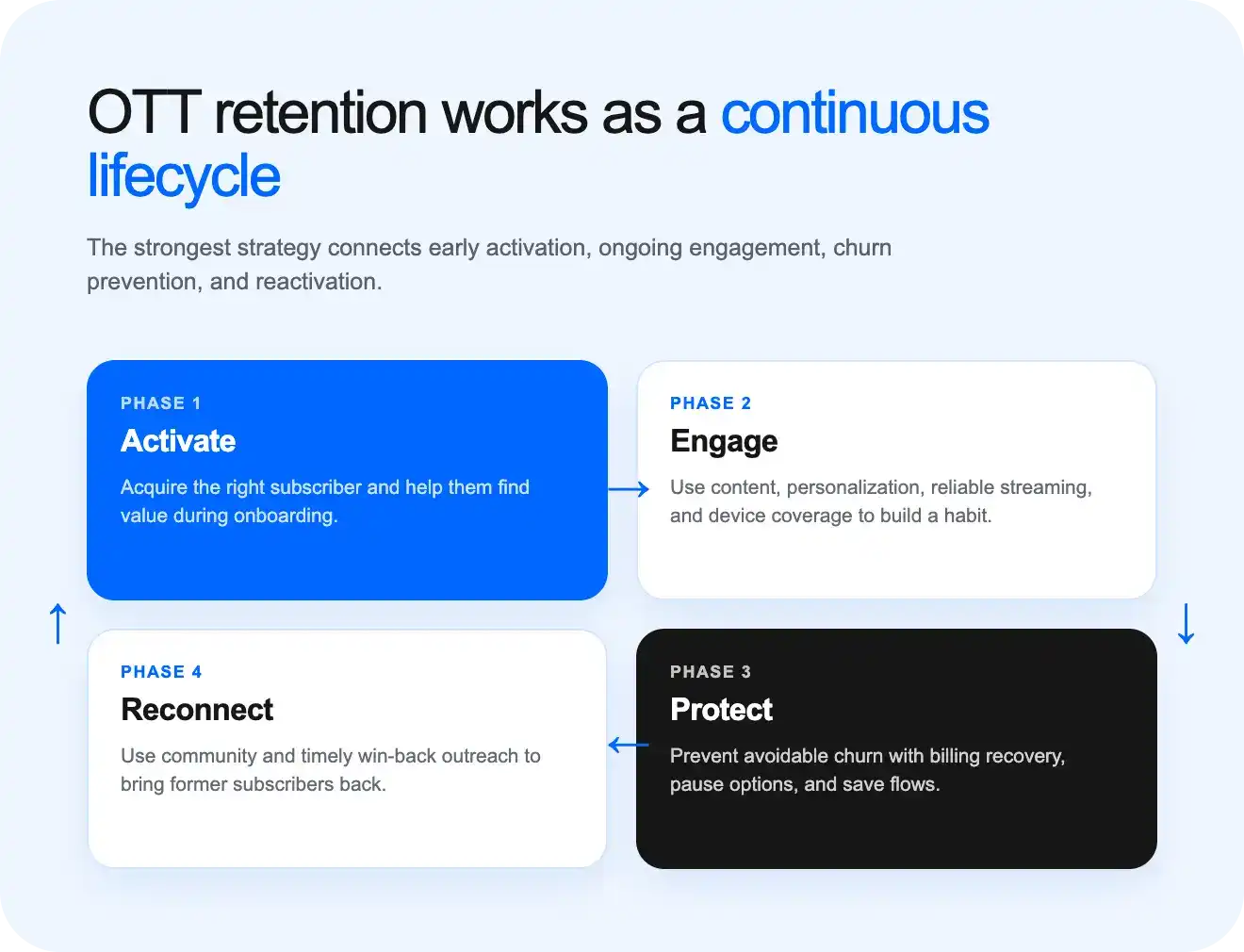
In practice, they map onto one continuous lifecycle:
Acquire → Onboard → Engage → Prevent churn → Recover payments → Community → Win-back
Onboarding and personalization help subscribers build viewing habits early. Billing recovery and pause options prevent avoidable cancellations, while engagement scoring and reliable streaming keep subscribers active over time. Community strengthens long-term loyalty, and win-back campaigns give former subscribers a reason to return.
Each stage supports the next. The strongest retention strategies (opens in new tab) combine all of them instead of relying on a single tactic.
A 90-day retention roadmap
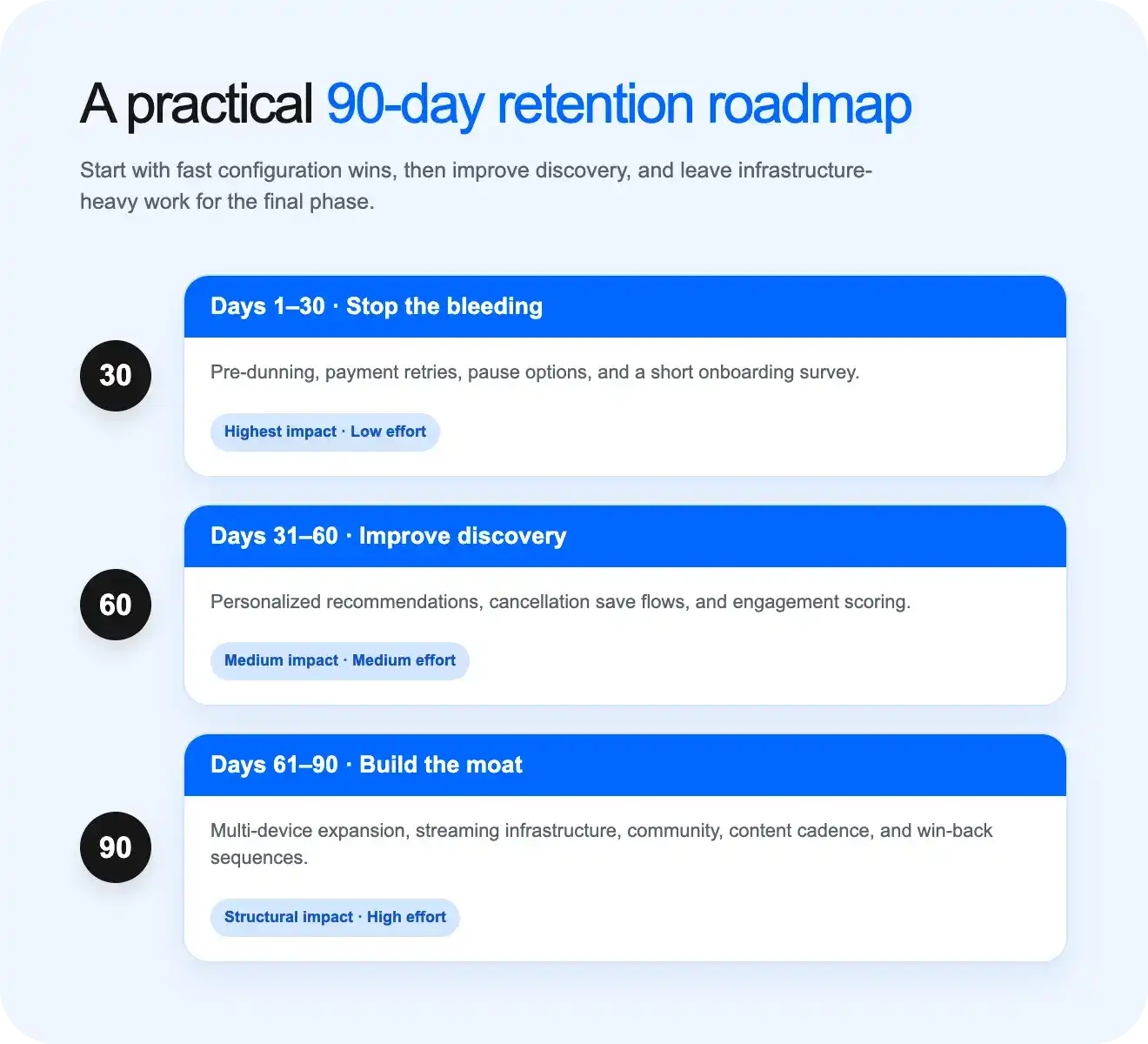
Ten strategies without a sequence is overwhelming. The table below ranks each tactic by impact and implementation effort. It shows where to start instead of trying to tackle all ten strategies at once.
| Impact | Timeframe | Focus | Tactics from this article | Typical effort |
|---|---|---|---|---|
| Highest | Days 1 to 30 | Stop the bleeding | Pre-dunning, payment retry logic, pause option, onboarding survey | Low |
| Medium | Days 31 to 60 | Engagement and discovery | Personalized recommendations, cancellation save flow, (opens in new tab) engagement scoring | Medium |
| Structural | Days 61 to 90 | Long-term investment | Multi-device expansion, stream quality infrastructure, community features, content pipeline cadence, win-back sequences | High |
The order is deliberate, not arbitrary. Everything in row one is a configuration change you can ship this week. Everything in row three requires either app development or infrastructure work, which is exactly why it belongs last, not because it matters less.
Put your retention strategy into practice with Uscreen
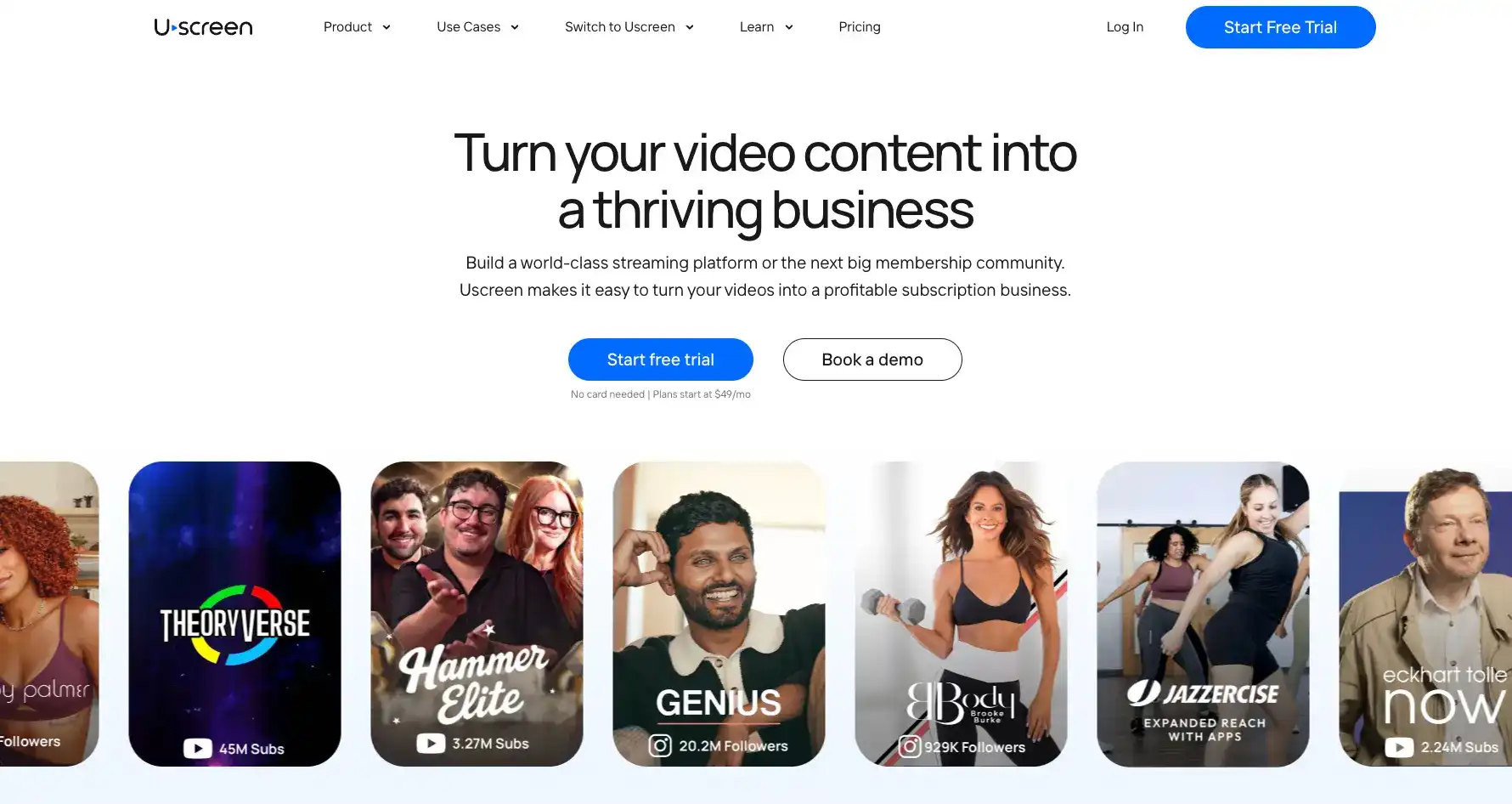
Reducing churn comes down to giving subscribers a better experience from their first login to every renewal. That means combining reliable billing, personalized content discovery, strong community features, and a streaming experience people want to come back to. Uscreen brings all of that into one platform, so you’re not stitching these pieces together yourself.
If you’re evaluating Uscreen, here’s where to start:
- Membership tools (opens in new tab) : See how subscriptions, billing recovery, and subscriber management work together.
- Community features (opens in new tab) : See how discussions, challenges, and subscriber spaces help keep subscribers engaged between releases.
- Video experience (opens in new tab) : Explore the playback, apps, and cross-device viewing experience your subscribers expect.
- Plans and pricing (opens in new tab) : Compare available features and choose the plan that fits your business.
Beyond the platform itself, Uscreen provides ongoing coaching and personalized growth strategies to help you improve both acquisition and retention. Whether you’re launching your first streaming business or improving retention for an established one, Uscreen can help you spend less time fighting churn and more time growing your audience.