
If you last looked into OTT monetization a couple of years ago, the landscape has moved on. It used to come down to picking one lane: subscriptions, ads, or pay-per-view. In 2026, most successful video businesses run two or three of these at once, and FAST channels have joined the regular lineup alongside the familiar SVOD, AVOD, and TVOD trio.
Here’s what you’ll get from this guide:
- Every current OTT monetization model, explained in plain terms
- A real example behind each one
- A straightforward way to figure out which model (or combination) fits your content and your audience
What is OTT monetization?
OTT monetization is the process by which a streaming business turns viewers into revenue. OTT stands for “over-the-top,” meaning your content streams directly over the internet rather than through cable or satellite.
Here’s the part most people miss, though. Think about YouTube for a second. You upload a video, YouTube runs an ad on it, and YouTube decides how much of that ad money trickles down to you. Cool, but you’re renting an audience you don’t actually own.
OTT flips that entirely. Your audience pays you directly (or gets monetized directly through your own business), not through some third-party ad network that changes its rules whenever it feels like it. You set the price. You own the relationship. And the money hits your account first, not YouTube’s, not anyone else’s.
The key to success is owning the pipeline that connects your content to your revenue, rather than relying on others.
The 6 OTT monetization models
There isn’t one “right” way to make money from streaming. Here are all the models that matter for a current OTT business strategy.
SVOD (subscription video on demand)
What is it? Members pay a recurring fee (usually monthly or annually) for unlimited access to your library. Once someone subscribes, you’re not chasing a new sale every time they want to watch something, which is why this model is the default starting point for most membership businesses.
Example: (opens in new tab) Netflix (opens in new tab) and (opens in new tab) Amazon Prime Video (opens in new tab) are built on this exact model. It’s the backbone of most membership businesses because it turns one-time viewers into a predictable, recurring income stream.
AVOD (advertising video on demand)
What is it? Your content is free to watch, and ads pay the bills instead of your audience. It only really works at scale. You need a large, consistent audience for ad revenue to add up to anything meaningful. For a niche membership business, that scale is usually the hard part.
Example: (opens in new tab) YouTube (opens in new tab) is the best-known example. Without millions of consistent viewers behind you, ad revenue rarely adds up to much, which is why most niche businesses skip this model entirely.
TVOD (transactional video on demand)
What is it? A one-off payment for a single piece of content: a live event, a workshop, a premiere, or a single course. Think of it as the streaming version of renting a movie. It works well when you have something time-sensitive or high-value that people will pay for once, even if they’re not ready to commit to a subscription.
Example: (opens in new tab) Apple TV (opens in new tab) and (opens in new tab) Google TV (opens in new tab) built their entire movie and TV rental businesses on this exact model, charging per title instead of a recurring fee.
FAST (free ad-supported streaming television)
What is it? Scheduled, linear-style programming delivered over the internet, funded entirely by ads like AVOD. The difference is structure: instead of choosing what to watch, viewers tune into a fixed lineup, much like they would with traditional TV. It’s built for large content libraries chasing broad, passive reach, a different game than running a niche membership.
Example: (opens in new tab) Pluto TV (opens in new tab) is the clearest example of a platform built entirely around this model. (opens in new tab) Samsung TV Plus (opens in new tab) has made it a standard, pre-installed feature on its smart TVs, which is a big part of why FAST has become one of the more talked-about growth stories in streaming.
Hybrid
What is it? Combining two or more monetization types so members can choose how they want to pay. It’s a practical way to capture different levels of buying intent instead of forcing everyone through the same door.
Example: ESPN+ (opens in new tab) runs this way, combining a recurring subscription with standalone pay-per-view purchases for major UFC events, letting subscribers upgrade to a one-off purchase without leaving the platform.
Membership
What is it? A recurring subscription (same mechanics as SVOD) built around retention, not just access. It adds a community layer, discussion, direct interaction with you, events, so members stick around for the relationship, not just the content
Example: (opens in new tab) Means TV (opens in new tab) runs on this model, an all-in-one membership experience built around community rather than content alone. Members who feel like they belong to something stick around, which is part of how Means TV grew to $40,000+ in monthly revenue and doubled its Black Friday sales year over year.
How to choose the right OTT monetization model for your business
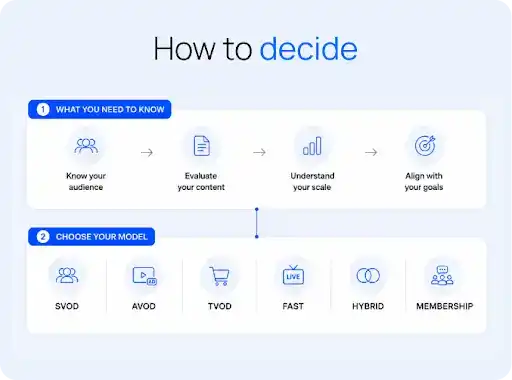
Most people spend way too long agonizing over this decision, and honestly, it’s not as high-stakes as it feels. I’ve watched creators sit on a launch for months trying to pick the “perfect” model, when the truth is the model tends to reveal itself once you look honestly at what you already have.
A course creator with one flagship program isn’t going to force-fit a subscription just because it sounds more sophisticated. And a fitness instructor with a loyal, daily-watching audience is leaving money on the table if they don’t turn that into recurring revenue.
If there’s one pattern worth paying attention to right now, it’s that hybrid has quietly become the default. A few years ago, most businesses picked one model and stuck with it.
These days, with subscription fatigue pushing back on pure SVOD plays, the businesses doing best are stacking a subscription with an occasional one-off sale, or pairing content with an actual community. Give your audience more than one way to say yes, and they usually will.
Here’s a quick way to think it through:
| Your content and audience | Best-fit model |
|---|---|
| Large content library, chasing broad reach | AVOD or FAST, assuming your platform supports them |
| A single high-value course, event, or premiere | TVOD, as a standalone offer |
| An engaged audience that wants ongoing access | SVOD, for predictable, recurring revenue |
| A business built on content plus real connection with your audience | Membership, designed around that connection |
| Most real businesses | Hybrid, combining two or more of the above |
OTT revenue trends and challenges in 2026
The global OTT industry is worth $383.52 billion in 2026 and is projected to reach $626.69 billion by 2031, according to Mordor Intelligence (opens in new tab) , with a compound annual growth rate above 10%. That’s still a lot of room to build a business in.
But growth doesn’t mean it’s easy. Subscription fatigue is a real pressure on pure-SVOD businesses right now. Churn among streaming subscribers has held steady at around 40%, and nearly three-quarters of U.S. streaming customers say they’re frustrated that the services they pay for keep raising prices, according to Deloitte’s 2026 Digital Media Trends study (opens in new tab) . Canceling one service to try another has become routine, not a big decision.
That’s why hybrid and membership approaches are gaining ground. When one lever softens (a subscriber trims their monthly bill, say), a business with a second revenue stream or a community that gives people a reason to stay has something to fall back on. A business running on subscriptions alone doesn’t.
Run your model on Uscreen
Whether you land on SVOD, TVOD, a hybrid mix, or a full membership model, the platform running underneath it needs to keep up without becoming its own project.
Uscreen natively supports all four, with multi-tiered subscriptions, one-time purchases, and bundles built in from the start. Members can upgrade or downgrade without canceling and starting over, which is when many platforms lose people right as they’re trying to spend more.
More than 4,000 customers have used Uscreen to collectively earn over $210 million a year, with over 3,500 branded apps launched along the way. If you’ve settled on a model, we can show you exactly how it runs day to day.
Book a demo (opens in new tab) .