
You don’t realize a platform wasn’t built for you until you’re already on it. You’ve migrated your content, moved your members, rebranded everything. Then you hit the ceiling. The feature you needed was on the marketing page. It just wasn’t built to work the way your business works.
Uscreen vs Brightcove is that kind of comparison. Both handle video and offer apps, live streaming, and monetization. But they serve fundamentally different operations, and choosing the wrong one only becomes clear once you’re already on it.
Here’s how to tell which video platform fits your business without having to find out the hard way.
We evaluated each platform based on their pricing pages, public product documentation, and third-party contract data where Brightcove pricing isn’t published.
Uscreen vs Brightcove: side-by-side comparison
| Feature | Uscreen | Brightcove |
|---|---|---|
| Best for | Independent video businesses building recurring revenue through a membership or subscription model. | Broadcasters, media networks, and large communications teams needing enterprise-scale video infrastructure |
| Pricing visibility | Published on Uscreen’s own pricing page | Quote-based only, not published |
| Built-in website/app builder | Yes, branded website on every plan; mobile apps from App Essentials up; TV apps on Custom | App builder available through Beacon Studio; no built-in branded website or membership site builder |
| Community features | Yes, built-in (channels, polls, challenges, direct messages) on the Custom plan | Not offered natively, per Brightcove’s own product pages (opens in new tab) |
| Marketing/CRM tools | Yes, built-in (email automations, lead capture, segmentation) | Integrates with external CRM and marketing platforms; no native equivalent |
| Live streaming | Yes, native live streaming on every plan | Yes, supported across Media Studio and Communications Studio |
| Monetization models | Subscriptions, rentals, pay-per-view, one-time purchases, bundles | AVOD, SVOD, TVOD, and hybrid combinations |
| Contract type | Starter is monthly-only; Growth and App Essentials offer monthly or annual billing; Custom is quote-based | Typically annual (third-party reported, per Vendr contract (opens in new tab) (opens in new tab) data (opens in new tab) ) |
| Vendor ownership stability (2026) | Independent, took a $150M growth investment from PSG in February 2025 | Acquired by Bending Spoons for $233 million, deal closed February 2025; laid off 198 employees, roughly two-thirds of its US staff, in March 2025 |
What is Brightcove?
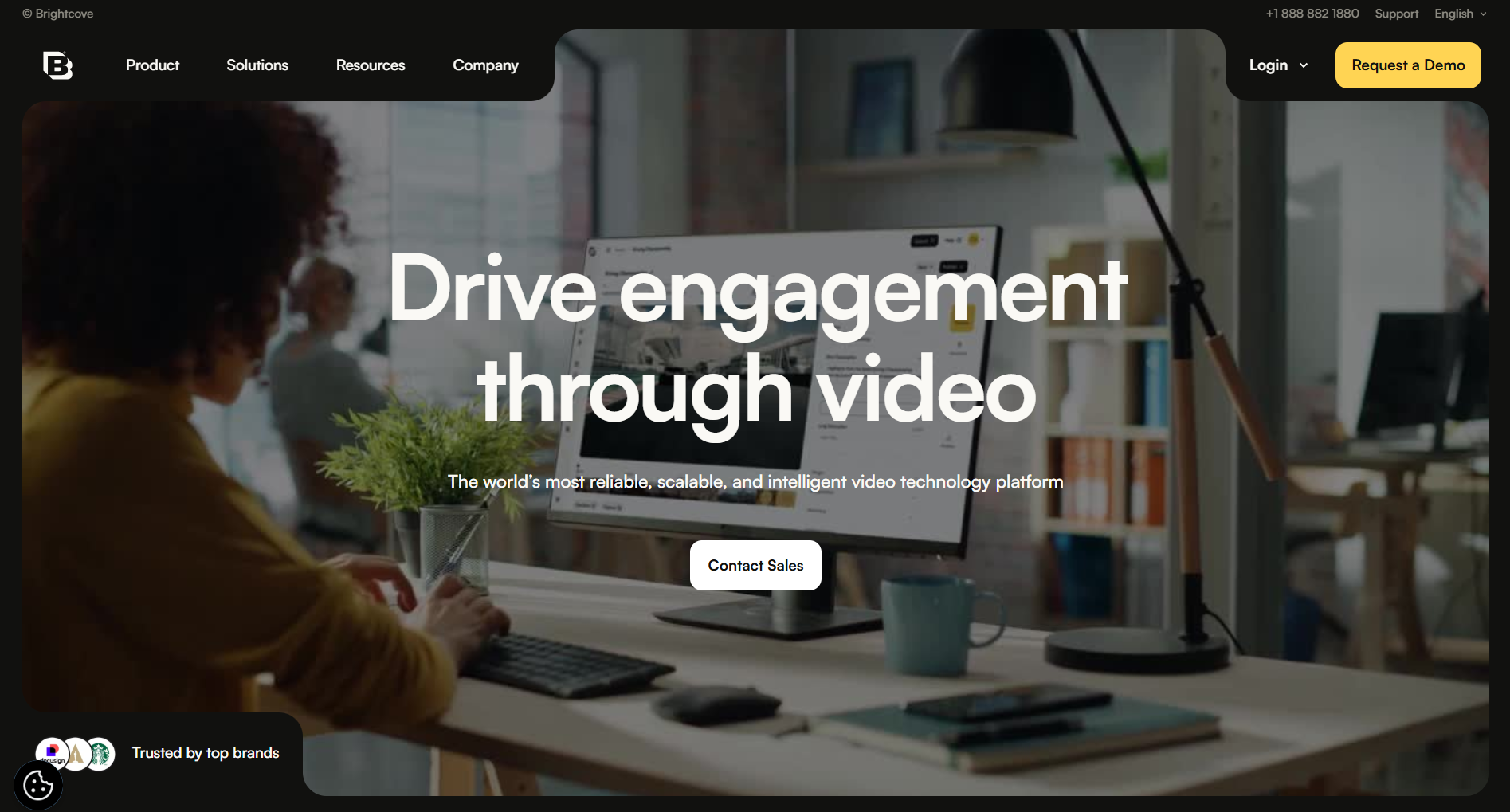
Brightcove (opens in new tab) is a video platform built for large organizations: broadcasters, media networks, financial services firms, and communications teams that need to host, stream, and deliver video at scale. It’s the kind of infrastructure a major media brand or a global bank’s internal communications team reaches for. You won’t find a single, self-serve Brightcove product.
Instead, Brightcove sells through packaged solutions built for different use cases:
- Media Studio (opens in new tab) for media and over-the-top (OTT) delivery
- Marketing Studio (opens in new tab) for video-driven marketing teams
- Beacon Studio (opens in new tab) for building standalone streaming apps
- Communications Studio (opens in new tab) for internal and corporate communications
Each one is quoted and configured around your specific setup.
On the device side, Brightcove covers real ground. It offers OTT streams (opens in new tab) to iOS, Android, Apple TV, Android TV, Roku, Amazon Fire TV, tablets, and, through smart TV SDKs, Samsung and LG televisions. Brightcove’s own product pages describe video hosting, delivery, and integrations with your existing marketing stack.
If you want a member-facing site or engagement tools beyond video itself, you’ll need to connect third-party software to get there.
What is Uscreen?
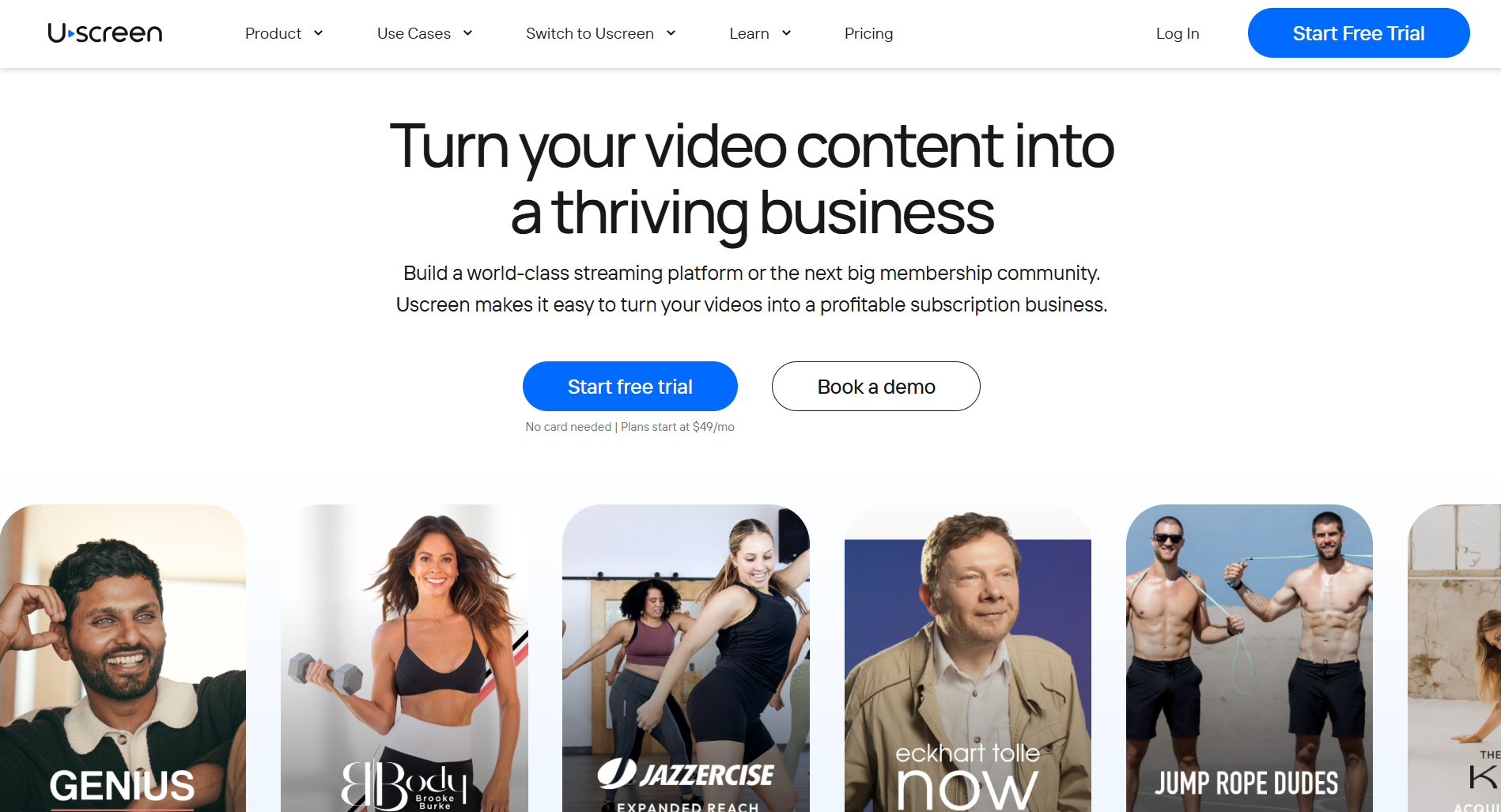
Uscreen (opens in new tab) serves independent video businesses that want to own their audience, build recurring subscription revenue, and run everything from one place, without hiring engineers or stitching together five separate tools.
Most video businesses start out running on a patchwork stack. A video host here, an email tool there, a separate community platform, a developer for the apps. Every week something breaks or doesn’t sync.
Uscreen replaces that entire stack with a single system: video hosting, a branded website, live streaming (opens in new tab) , and marketing tools (opens in new tab) , all on a single login and dashboard.
The App Essentials plan is where branded mobile apps come in: iOS and Android, built and maintained by Uscreen’s team, no engineering required on your end. On the Custom plan, you also get TV apps and community features like channels, polls, and direct messaging.
The audience relationship stays yours throughout. Your member data, your pricing, your revenue. Uscreen is the platform; you own the business running on top of it.
Thousands of video businesses run on Uscreen today. Those businesses have generated over $210 million in customer earnings in the past 12 months.
Uscreen vs Brightcove pricing: what you’ll actually pay
Uscreen (opens in new tab) publishes its pricing (opens in new tab) directly on its website. Brightcove doesn’t publish pricing anywhere. Its Studio pages direct you to contact sales for a quote built around your bandwidth, storage, and play count.
Third-party contract data from Vendr puts typical annual Brightcove spend between $20,000 and $250,000 or more depending on deployment size, though Brightcove has not confirmed those figures publicly. If you want a number you can plan around before talking to a salesperson, Uscreen is the one that gives you that.
| Factor | Uscreen | Brightcove |
|---|---|---|
| Published pricing | Yes, on Uscreen’s own pricing page | No, quote-based only |
| Entry-level monthly cost | $49/month (Starter, capped at 100 subscribers; 10% fee on one-time sales) | Not published; no reliable third-party figure found |
| Subscriber/usage fees | $0 to $1.99 per subscriber, depending on plan | Usage-based: bandwidth, storage, and play count, per Brightcove’s own product listing |
| Typical annual spend | $600 to $6,000+, depending on plan and subscriber count | $20,000 to $250,000+ (third-party estimate, per Vendr contract data) |
| Contract requirement | Monthly available on Starter; annual billing option on other tiers | Typically annual (third-party reported, per Vendr) |
How do Uscreen and Brightcove handle monetization?
Brightcove is built to support ad-supported and subscription models running side by side, with monetization tools covering AVOD, SVOD, and hybrid setups that mix advertising with paid tiers. If you’re running a large media operation testing multiple revenue paths on a big content library, that flexibility matters.
Uscreen goes narrower on purpose:
- Monetization: Subscriptions, rentals, pay-per-view, one-time purchases, and bundles, built around one goal: recurring membership revenue. You can mix models (a subscription plus one-off purchases, for instance), but nothing here is designed to test an ad-supported tier against a paid one.
- Product architecture: Uscreen’s video library, live streaming, and community tools come as one connected product, same login, same dashboard, same member data.
Brightcove takes the opposite approach on architecture. Its own product pages describe integrations with external marketing and CRM platforms rather than a built-in equivalent, so covering community or marketing on Brightcove typically requires adding separate software.
Which platform gets your app live faster?
The real difference between Uscreen and Brightcove on apps isn’t which screens they reach. Both reach the web, iOS, and Android. Brightcove also covers Apple TV, Android TV, Roku, and Fire TV through Beacon Studio. On Uscreen, TV platforms (Apple TV, Android TV, Roku, Fire TV, and Samsung TV) are available on the Custom plan. The difference is what it takes to get your brand live on those screens, and how long it takes.
Where they differ is the launch process:
- Uscreen: You don’t need a product team or an engineering budget to get your brand onto iOS, Android, Apple TV, or Roku. Uscreen builds, submits, and maintains your branded apps. Most launch within 30 to 60 days.
- Brightcove: No published launch timeline. App development is scoped alongside your broader contract (product tier, integrations, usage commitments) through a quote-based, consultative sales process, which means more upfront setup conversation; there’s no published number to compare directly.
Uscreen vs Brightcove: which one to choose?
Choosing between Uscreen vs Brightcove comes down to one question: what kind of video business are you running? Brightcove is enterprise video infrastructure built for broadcasters, media networks, and large communications teams with existing engineering resources. If you need ad-supported monetization at scale, it’s a serious option.
If you’re building a subscription business around a content library and a paying community, Uscreen is exactly what you need. It’s a complete membership platform for independent video businesses that want to own their audience, their app, and their revenue, without assembling a technical stack to get there.
Where Uscreen is the stronger choice:
- Built for memberships from the ground up: Your business runs on subscriptions, community, and direct audience relationships, and you want a platform that handles all of it.
- Visible pricing, faster path to launch: Uscreen publishes its pricing and builds, submits, and maintains your branded apps for you, so you’re not waiting on a sales quote or a custom development timeline to get started.
- One connected platform: Your website, apps, live streaming, and marketing automation run on one login and one dashboard, with community and TV apps available as you scale up, instead of a handful of tools that each handle one piece of the job.
Where Brightcove is the stronger choice:
- Enterprise-scale monetization: You’re a large media company, broadcaster, sports property, or brand that needs ad-supported and hybrid monetization running at enterprise scale.
- Infrastructure layer only: You already have engineering and marketing infrastructure in place and only need the video delivery layer.
- Consultative sales process: Your team is comfortable negotiating a custom contract tailored to usage, bandwidth, and storage, rather than selecting a published plan from a pricing page.
How to get started with Uscreen
Most video businesses switching platforms aren’t doing it by choice. They switch because they’ve outgrown what they’re on, or because the platform they trusted changed underneath them.
If you’re evaluating Uscreen after looking at Brightcove, the decision usually comes down to one thing: you want to own your subscription business outright on a platform built for exactly that, without a sales call standing between you and a price.
Here’s how to move forward:
- Start a free trial on the Starter plan: If you’re building toward your first recurring revenue, the (opens in new tab) Starter plan (opens in new tab) costs $49 a month and needs no credit card to begin. You get video hosting, a branded website, and live streaming from day one, so you can see the platform running before you commit.
- Book a demo for App Essentials or Custom: If you already have a paying audience and want branded mobile and TV apps as part of your launch, (opens in new tab) book a demo (opens in new tab) instead. The team will walk you through the plan that fits your current subscriber count and growth goals.
- Migrate off Brightcove with dedicated support: Uscreen’s (opens in new tab) Migration Team (opens in new tab) handles the full move. Your members are set up on Uscreen and can log in right away. Members sign in via a magic link sent to their email, no password needed. Payment methods carry over automatically, so there’s no disruptive billing ask during the transition.
- See how other video businesses have scaled on Uscreen: From (opens in new tab) MeansTV generating $40K a month (opens in new tab) to Abundance+ growing from $30K to $130K a month, the results come from fully owning the audience relationship.