
If you’re searching for “OTT app development,” you’re probably one of two people. Either you’re pricing out a custom build from a development agency, or you’re looking for a no-code way (opens in new tab) to launch a streaming app without hiring a single developer. Those two paths lead to wildly different costs and timelines, and most guides cover only one.
Agency quotes for a “typical” OTT app range anywhere from $8,000 to $600,000 or more, depending on who’s quoting and what you’re actually asking for.
This guide breaks down why the range is so wide, then lays out both paths honestly, side by side, so you can figure out which one actually fits your business.
What is OTT app development?
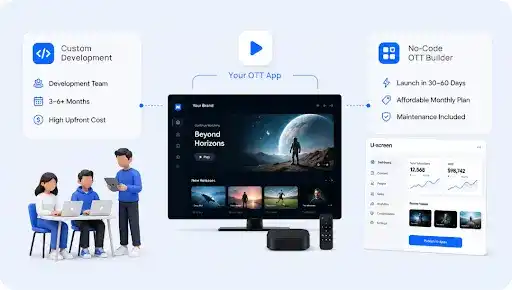
OTT (over-the-top) app development is the process of building software that streams video or audio straight to viewers over the internet, skipping cable and satellite entirely. “Over-the-top” refers to that bypass: the content rides over your regular internet connection instead of a dedicated broadcast pipe.
Netflix, Disney+, and YouTube are the names most people already know. The same category also covers fitness apps, niche education platforms, and independent streaming services built for a much smaller audience.
They all share the same core stack: a video player, a content library you can organize and update, and support across mobile, web, and TV. Then there’s some way to get paid, whether that’s subscriptions, one-time purchases, or ads.
Whatever path you choose, every OTT app needs the same core pieces working together:
- Video streaming infrastructure (opens in new tab) : Smooth, buffer-free playback so viewers actually stick around instead of bouncing at the first stutter.
- Content management backend: Upload, organize, and update your library without touching code.
- Multi-device support: Mobile, web, and smart TV apps, so your audience can watch wherever they already are.
- Monetization and payment integration (opens in new tab) : Subscriptions, one-time purchases, or a mix, so what you build actually generates revenue.
- Content protection: Keeps what you’ve built from being ripped off or redistributed without your permission.
OTT app development cost, and why the quotes you’ll get vary so wildly
Get quotes from three different development agencies, and you’ll likely walk away more confused than when you started. One agency quotes $8,000. Another quotes $60,000. A third quotes $150,000. All three are describing the same category of app.
Each agency has its own way of describing a “typical” project, based on the kind of clients and work they usually take on. An agency that primarily builds lean MVPs will naturally quote a low price. One that builds large, feature-heavy platforms for bigger clients will quote high. Neither is wrong; they’re just describing different jobs.
The honest answer is that OTT app development cost falls into three broad tiers, and where you land depends on how much complexity you’re actually asking for.
| App complexity | Typical cost range | What’s included |
|---|---|---|
| Basic/MVP | $8,000-$25,000 | Video streaming player, user login, basic content library, simple subscription setup, minimal admin panel |
| Mid-complexity | $25,000-$90,000 | Multi-device compatibility, push notifications, advanced search and filtering, watchlists, standard analytics |
| Fully-featured/enterprise | $90,000-$600,000 or more | AI-driven recommendations, live streaming at scale, DRM protection, multi-region support, advanced analytics dashboards |
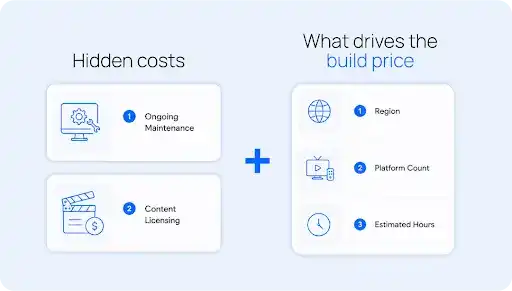
On top of whichever tier you land in, budget for two costs that rarely show up in the headline quote:
- Ongoing maintenance: Typically 15% to 20% of your build cost annually, for bug fixes, security updates, and keeping the app compatible with new OS versions.
- Content licensing: Entirely separate from development, and can be a bigger long-term expense than the build itself if you’re relying on licensed rather than original content.
Three things drive most of it.
Region matters more than people expect. A US-based team bills very differently than a team in Eastern Europe or South Asia, and that alone can shift a quote by tens of thousands of dollars before a single feature is discussed.
Then there’s platform count. A single mobile app costs far less than mobile plus five smart TV platforms, since each smart TV platform (Roku, Apple TV, Fire TV, and so on) is effectively its own build with its own testing cycle.
And finally, how the agency estimates hours. The same feature list can take 200 hours in one estimate and 500 in another, depending on how conservatively (or optimistically) the agency scopes the work up front.
The no-code alternative: OTT app builders
Instead of paying a large upfront fee and waiting months for a working app, a platform-based app builder operates more like a subscription service. You pay a fixed monthly or annual fee, and the platform handles the infrastructure, app store submissions, and ongoing maintenance for you.
| Path | Typical upfront cost | Typical timeline | Who maintains it |
|---|---|---|---|
| Custom development (agency or in-house) | $8,000-$600,000 or more | 3-6 months, sometimes longer | You, or whoever you hired |
| No-code OTT app builder (platform) | From $449/month + $0.99 per-subscriber fee, no high upfront cost | 30-60 days | The platform’s team |
With custom development, every bug, update, and new OS release becomes your problem to solve or pay someone to solve. With a platform like Uscreen (opens in new tab) , your branded iOS and Android apps launch on the App Essentials plan, with maintenance (new feature updates, bug fixes, and ongoing improvements) and app store resubmissions handled for you.
If you also need TV apps, they are included on the Custom plan, along with community features (opens in new tab) and a dedicated success manager.
Which path makes sense for your business
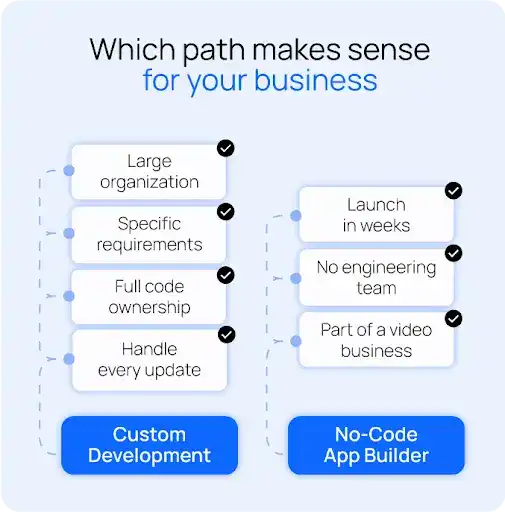
Custom development makes sense if you’re a large media organization with an in-house engineering team already on payroll, or if you have highly specific technical requirements that no existing platform supports. It’s also the right call if you need full source-code ownership and are prepared to handle every update and bug fix yourself.
A no-code app builder makes more sense if you want to launch in weeks, not months, and you don’t have (or don’t want) an engineering team. It’s also a better fit when your app is part of a broader video business, where it supports the business rather than being the product itself. The right path depends on your actual situation, not on which option sounds cheaper at first glance.
Launch your branded app on Uscreen
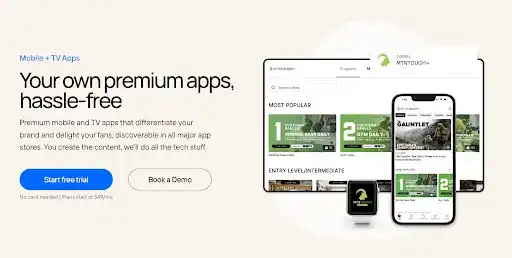
If the no-code path fits the way you run your business, here is what it looks like in practice. Your branded iOS and Android apps go live on the App Essentials plan, starting at $449/month, with app store resubmissions and ongoing maintenance handled for you, rather than being billed back to you every time something breaks.
Want TV apps in the mix too? Those come with the Custom plan, along with community features and a dedicated success manager.
That’s a fixed monthly cost instead of a five- or six-figure upfront bill, and a live app in 30 to 60 days instead of a development team you have to manage for the next six months.
See pricing (opens in new tab) to find the plan that fits, or (opens in new tab) book a demo (opens in new tab) to see how quickly a branded app can go live.