
Kajabi pricing starts at $143/month on annual billing. It offers three plans: Basic, Growth, and Pro. Uscreen, built for video membership businesses, starts at $49/month on its Starter plan. This article breaks down each plan, the fees, and what Kajabi includes. It also covers why Uscreen is a stronger alternative for video membership businesses.
What is Kajabi?
Kajabi (opens in new tab) is an all-in-one platform for course sellers, coaches, and digital product businesses. It bundles course hosting, email marketing, a website builder, sales funnels, community, and podcast hosting. Checkout sits under the same subscription too.
Kajabi was founded in 2010 and is headquartered in Irvine, California. It has gone through several major platform overhauls since then. The most recent came in January 2026, raising prices and adding new features.
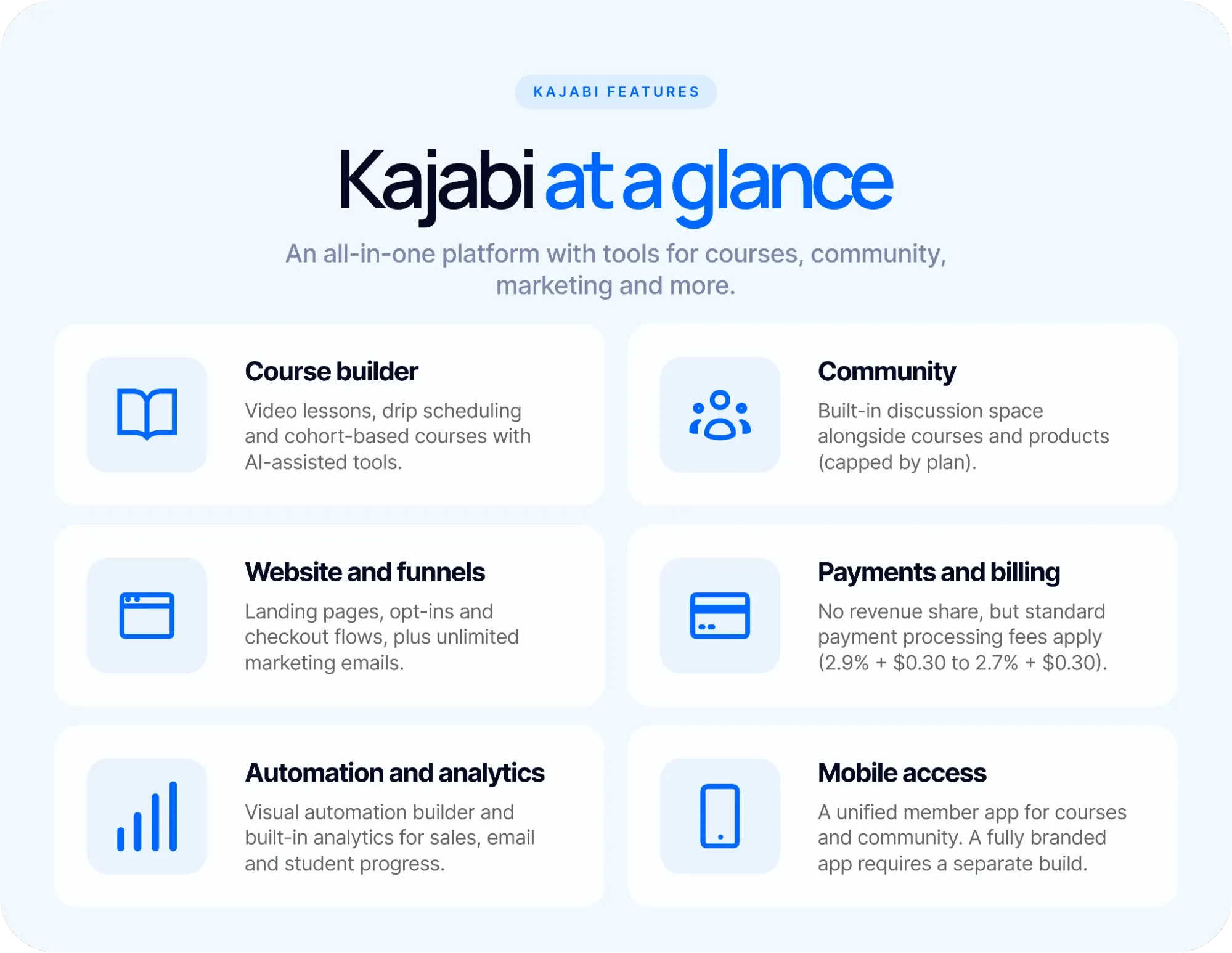
Here are the key features of Kajabi:
- Course builder: Kajabi’s classroom supports video lessons, written content, drip scheduling, and cohort-based courses. Courses can include deadlines and set pacing. It also includes AI-assisted tools for building course outlines, transcriptions, translations, and dubbing.
- Community: Community is a built-in discussion space that sits alongside courses and products, but it’s capped by plan. Basic and Growth each get one community, while Pro gets three. You can’t buy additional communities as an add-on. Community lives in its own section, separate from the lesson flow. Finishing a lesson does not automatically take students to a related discussion thread.
- Website and funnel builder: Kajabi includes tools for landing pages, opt-ins, and checkout flows. Every plan also includes unlimited marketing emails. Design flexibility is limited compared with dedicated builders. Pixel-level positioning or broken grid layouts require custom code on Pro.
- Payments and billing: Kajabi doesn’t take a revenue share on any plan, but it does charge standard payment processing fees through Kajabi Payments, ranging from 2.9% + $0.30 on Basic down to 2.7% + $0.30 on Pro.
- Automation and analytics: A visual automation builder supports branching logic and templates for email and marketing sequences. Analytics track opt-ins, purchases, revenue, email open and click rates, video completion, and student progress in one dashboard. Reporting is mostly aggregate, with limited attribution for paid traffic.
- Mobile access: Kajabi offers a unified Member Mobile App for courses and community. Members can use Kajabi’s shared customer app for free. A branded app with your own App Store and Google Play listing is included on Pro, or costs $199/month as an add-on on Basic and Growth.
How much does Kajabi cost per month?
Kajabi’s pricing starts at $143 a month on annual billing or $179 a month on monthly billing. Growth costs $199 annually or $249 monthly. Pro costs $399 annually or $499 monthly. Annual billing saves about 20% on any tier.
The trade-off is paying the full year upfront. Check your cash flow before committing.
| Plan | Monthly price | Annual price (per month) | Annual total | Savings vs. monthly |
|---|---|---|---|---|
| Basic | $179 | $143 | $1,716 | $432/year |
| Growth | $249 | $199 | $2,388 | $600/year |
| Pro | $499 | $399 | $4,788 | $1,200/year |
What’s included in each Kajabi plan
The three plans mainly differ in how much you can build. That includes products, contacts, and team members. A few tools are unlimited no matter which plan you pick, like funnels, landing pages, and marketing emails.
| Feature | Basic | Growth | Pro |
|---|---|---|---|
| Products | 5 | 50 | Unlimited |
| Contacts | 2,500 | 25,000 | 100,000 |
| Websites | 1 | 1 | 3 |
| Communities | 1 | 1 | 3 |
| Admin users | 2 | 11 | 26 |
| Branded mobile app | $199/mo add-on | $199/mo add-on | Included ($199/mo value) |
| API access | Not included | Not included | Included ($25/mo value) |
| Custom code editor | Not included | Not included | Included |
| Affiliate program | Not included | Included | Included |
What happened to the Kajabi Kickstarter plan?
Kajabi’s Kickstarter plan still exists, technically, but it’s no longer on the public pricing page. Kajabi’s own help documentation still recognizes Kickstarter for existing customers. New customers can’t sign up for it today.
That’s exactly why older articles still quote Kickstarter prices around $69/month. Those numbers were accurate when Kickstarter was publicly available. They no longer match Kajabi’s current pricing page for new signups.
Kajabi transaction fees and payment processing costs
Kajabi takes no revenue share. You still pay card processing through Kajabi Payments: 2.9% + $0.30 on Basic, dropping to 2.7% + $0.30 on Pro.
If you use your own processor, like Stripe, instead of Kajabi Payments, Kajabi adds a platform surcharge: 2% on Basic, 1% on Growth, 0.5% on Pro. That surcharge doesn’t apply to PayPal.
Extra fees most reviews miss. These are Kajabi’s US rates (they differ by country) per Kajabi’s help center (opens in new tab) ):
| Fee | Rate |
|---|---|
| International cards | +1.5% |
| Subscription/payment-plan surcharge | +0.7% on recurring transactions |
| Currency conversion | +1% |
| ACH bank transfer | 0.80%, capped at $5 |
| Instant payout | 1.5%, $0.50 minimum |
| Payment dispute | $15 per disputed transaction |
| Klarna | 5.99% + $0.30 |
| Afterpay | 6% + $0.30 (plus 1.5% cross-border) |
Is there a Kajabi free plan or discount?
Kajabi doesn’t have a free plan or a permanent discount program. The standard 14-day free trial is the only way to try Kajabi without paying. Every plan also comes with a 30-day money-back guarantee, so you can get a refund in your first month if Kajabi isn’t a fit.
The only real savings on a paid plan is annual billing, which cuts about 20% off any tier. Public coupon codes for bigger discounts almost never work; most are expired or were never real. There is no nonprofit rate, education pricing, or free tier once your trial ends.
Kajabi pricing changes in 2026
In January 2026, Kajabi raised prices across all plans (opens in new tab) . Existing customers saw the increase on their next billing cycle. Founder and Beta Invite plans were the exception. They kept their old prices and gained access to new features.
Beyond the plan price and processing fees, budget for extra contacts, third-party tools, and outside migration help.
Other Kajabi costs to budget for:
- Extra contacts: Kajabi sells additional blocks of 25,000 contacts for $125 a month. You can add them on any plan after reaching your contact limit.
- Third-party integrations: Kajabi connects to tools like Zapier for automations that aren’t built in natively. Those integrations run on their own separate subscription, on top of whatever you pay Kajabi.
- Migration help: Kajabi’s pricing page doesn’t list migration services. If you’re moving from another platform, you’ll handle migration yourself or hire outside help. Rates vary widely depending on who you hire.
How Kajabi pricing compares to alternatives
| Platform | Entry price (per month) | Fees on sales |
|---|---|---|
| Kajabi (opens in new tab) | $143/mo (billed annually) | No platform fee; 2.9% + $0.30 processing on Basic via Kajabi Payments |
| Uscreen (opens in new tab) | $49/mo (Starter, monthly only) or $149/mo (Growth, billed annually) or $449/mo (App Essentials, billed annually) | No subscriber fee (Starter, 100-subscriber cap) or $1.99/subscriber/month (Growth) or $0.99/subscriber/month (App Essentials) |
| Teachable (opens in new tab) | $29/mo (billed annually) | 7.5% on Starter, 0% on higher plans; plus 2.9% + $0.30 processing |
| Thinkific (opens in new tab) | $40/mo (billed annually) | No platform fee; 2.9% processing with Thinkific Payments |
Uscreen’s Starter plan has no per-subscriber fee, up to 100 subscribers. On Growth and App Essentials, a per-subscriber fee applies, and it gets smaller as you move up. Kajabi has no per-sale platform fee, but each plan caps your contacts, and extra contacts cost $125 a month per 25,000.
Is Kajabi worth the cost?
Kajabi can be worth it when you already pay separately for email, websites, courses, and funnels. Bundle those four into one bill and Kajabi’s price stops feeling steep. It’s harder to justify if you only need course delivery and nothing else.
Here’s how that breaks down depending on what you’re running:
- Course sellers with a small catalog: Basic works with five products or fewer. It also suits lists under 2,500 contacts. You get a full website, funnels, and email marketing included. The contact cap is the first thing you’ll hit as you grow, and that’s when the math changes.
- Coaches running cohorts or calls: Growth is the natural landing spot. The jump from 2,500 to 25,000 contacts matters. So does the move from 2 to 11 admin users. Those increases matter more than the extra $56 per month.
- Membership businesses: Look carefully before committing. Kajabi was built for courses first and added community features later. If engagement and retention drive your model, test the community experience carefully. Test how it feels from a member’s perspective, not just what’s on the feature list.
- Small businesses replacing multiple tools: This is where Kajabi’s all-in-one pitch is most defensible. Kajabi can replace ConvertKit, a funnel builder, and a course platform. That can simplify your stack if you’re paying for those tools separately. Run the numbers against what you’re currently spending before deciding it’s expensive.
Looking for a Kajabi alternative built for video?
Kajabi works well for course sellers and coaches. But if video memberships are your core product, the platforms are built differently. That difference starts at the foundation. We built Uscreen for video membership businesses from day one. It wasn’t added later to a course tool.
Here is what that difference looks like in practice:
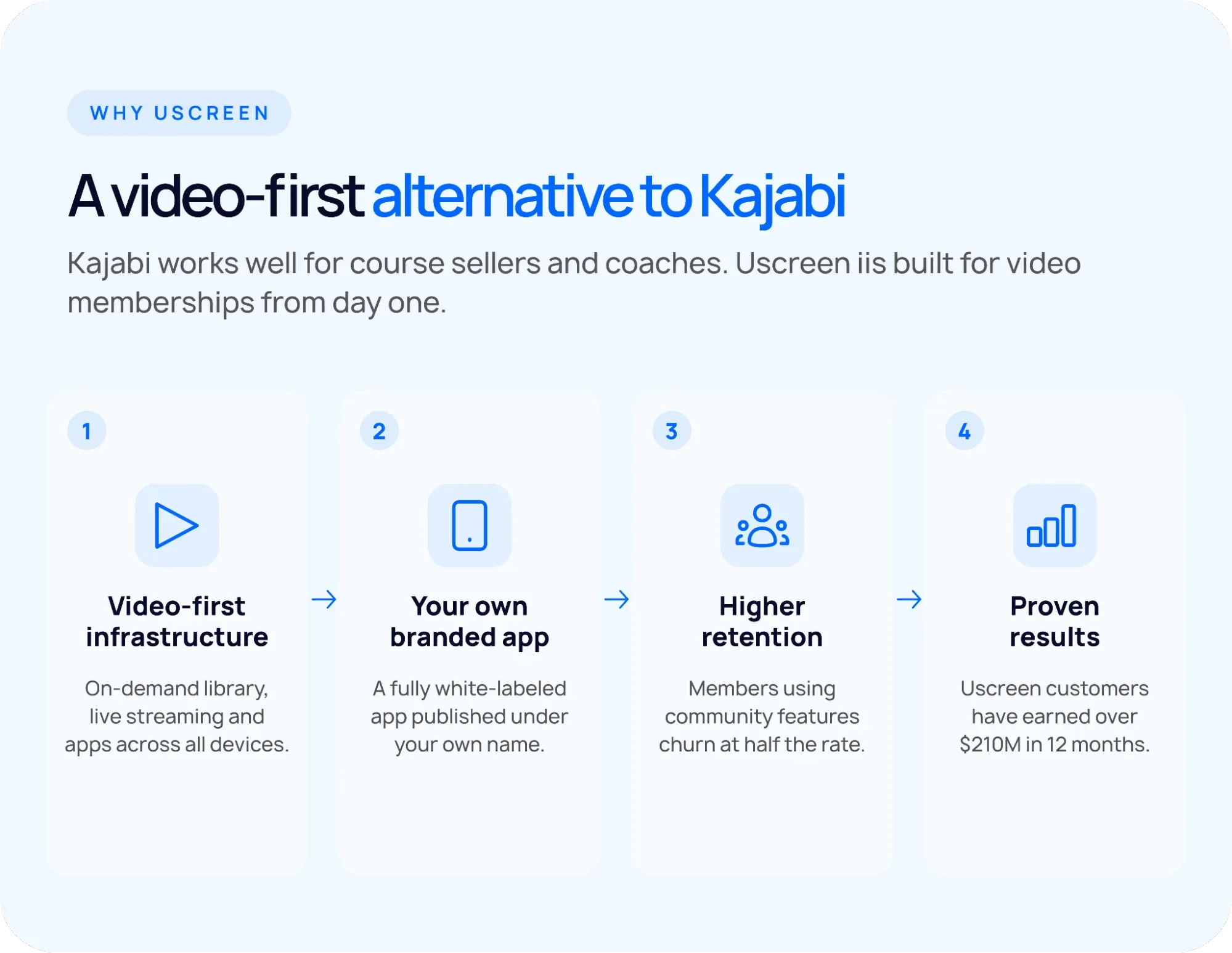
- Video-first infrastructure: Uscreen uses a Netflix-style on-demand library with native live streaming and interactive chat.
- Your own branded app: From the App Essentials plan up, your iOS and Android apps are published under your own developer account, so members download your app by name. Branded TV apps for Roku, Apple TV, and Fire TV come with the Custom plan.
- Retention that compounds: Uscreen customers using Community (on the Custom plan) see 2x less churn, and the average member stays for 16 months.
- Earnings at scale: Uscreen customers have collectively earned $210M in the past 12 months. Nearly 1 in 5 earn six figures a year.
If you’re running or starting a video membership, see how Uscreen compares to Kajabi (opens in new tab) or (opens in new tab) start a 14-day free trial (opens in new tab) .